Buyer-focused answer
Quick answer for buyers
Steel structure damage report checklist after delivery: package numbers, component marks, damage photos, repair actions, claim evidence, and closeout records.
Main question
What should EPC buyers check when using the steel structure damage report checklist after delivery?
Quick answer
Steel structure damage report checklist after delivery: package numbers, component marks, damage photos, repair actions, claim evidence, and closeout records.
When to use this page
Use it before packing is closed, before shipment release, or when the site team needs receiving and handover evidence.
What to verify
Record shipment and package information; Describe the damage type clearly; Take photos that prove context; Separate delivery damage from site damage
Related next step
A steel structure damage report checklist after delivery helps EPC teams record damage while the evidence is still useful. Once steel members are unloaded, moved, repaired, or issued for installation, it becomes harder to prove when the damage happened, which package was affected, and whether repair or replacement is required.
This checklist is written for site receiving teams, project buyers, logistics coordinators, and quality inspectors handling exported steel structure components after arrival. It focuses on practical evidence and closeout control rather than legal claim language.
1. Record shipment and package information
Every damage report should start with clear shipment identification. A report that only says "several beams damaged" is not enough for repair approval, supplier clarification, or insurance discussion.
- Project name, purchase order, shipment batch, and delivery date.
- Container, truck, trailer, or package number.
- Component mark, bundle number, crate number, or small-parts box number.
- Packing list reference and drawing reference where possible.
- Receiving person, inspection person, and report date.
For the receiving context, use the site receiving checklist and the unloading checklist.
2. Describe the damage type clearly
The report should describe what is damaged and why it matters. Different damage types require different follow-up actions: coating touch-up, dimensional check, straightening, replacement, document correction, or installation hold.
| Damage type | What to record |
|---|---|
| Coating or paint damage | Area, depth, location, exposed steel, and repair requirement. |
| Galvanizing damage | Bare area, abrasion, white rust, thread condition, and repair method. |
| Bent or deformed member | Component mark, affected zone, measurement, and installation impact. |
| Damaged bolts or accessories | Box number, size, quantity, thread condition, and missing items. |
| Broken package or label | Package condition, missing label, wet packaging, or unreadable marks. |
3. Take photos that prove context
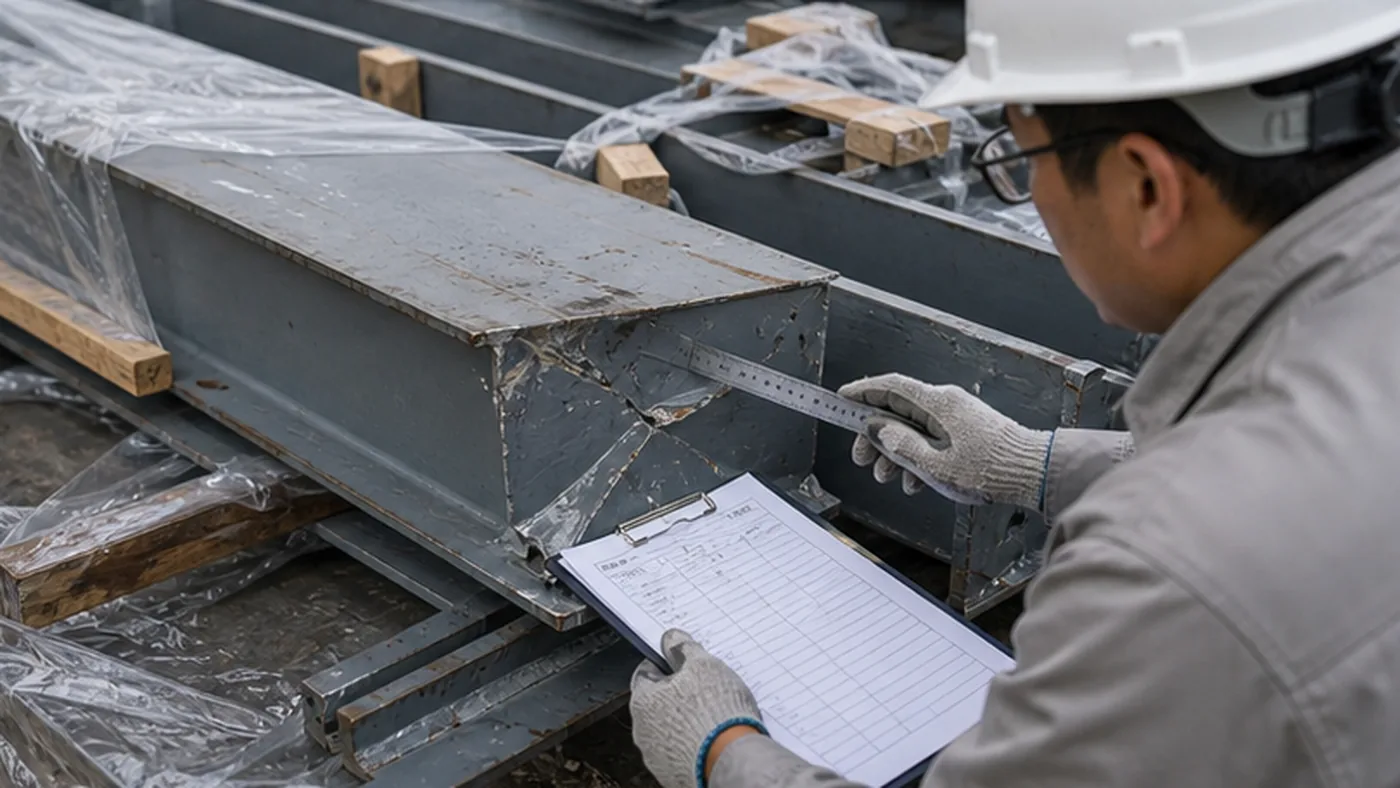
Photos should show both the close-up damage and the broader context. A close-up alone may not prove which component, package, or shipment was affected.
- Photo of the container, truck, or package number.
- Photo of component mark, bundle label, or box label.
- Wide photo showing the damaged item in the delivered condition.
- Close-up photo showing the damage clearly.
- Photo with scale, ruler, or measurement reference where useful.
- Photo file names linked to the damage report number.
4. Separate delivery damage from site damage
The receiving team should record whether the damage was visible before unloading, during unloading, after storage, or during site movement. This does not always decide responsibility immediately, but it helps prevent disputes based on vague timing.
| Timing | Evidence to check |
|---|---|
| Before unloading | Arrival photos, seal photos, container condition, and visible shifted cargo. |
| During unloading | Lifting photos, handling method, sling position, and equipment notes. |
| After site storage | Laydown area records, support condition, drainage, and movement register. |
| Unknown | State what is known and what evidence is missing. |
For storage-related evidence, compare with the site storage checklist.
5. Assess installation impact
Not every damage item has the same urgency. The report should state whether the item can be stored, repaired later, repaired before installation, held for engineering review, or replaced.
- Does the damage affect structural fit-up or alignment?
- Does coating or galvanizing damage require repair before storage or erection?
- Are holes, threads, slots, or connection surfaces affected?
- Is the component needed for the next installation sequence?
- Should the item be placed on quality hold?
6. Define repair, replacement, or acceptance action
A damage report should lead to a clear action. If the report only records the problem but does not identify the next step, damaged components may be installed without approval or sit unresolved in the laydown area.
| Action | When it may apply |
|---|---|
| Touch-up or coating repair | Minor coating damage with approved repair material and inspection record. |
| Dimensional inspection | Bent, twisted, or impact-damaged members need measurement before use. |
| Replacement request | Critical damage, missing parts, or unusable items. |
| Use as is | Only when authorized approval confirms no installation or quality impact. |
| Hold | When impact is unclear or approval is pending. |
For formal quality closeout, link the report to the nonconformance report checklist where required.
7. Keep a damage report log
Large projects may have many small damage records across multiple shipment batches. A simple log helps the project team track open issues, repair status, replacement needs, and claim evidence.
- Damage report number, date, and responsible person.
- Package number, component mark, and damage category.
- Photo folder reference and related packing or receiving document.
- Required action, owner, target date, and closeout status.
- Final decision: repaired, accepted, replaced, rejected, or claim submitted.
8. Close the report with evidence
A report should not be closed just because an email was sent. Closure should include evidence that the action was completed and accepted by the responsible party.
- Repair photos and inspection record.
- Replacement shipment or missing-part delivery evidence.
- Engineering or quality approval for use as is.
- Updated receiving, storage, or installation package record.
- Final closeout date and responsible person.
If the damage is connected with a missing box, mixed accessory package, or broken bolt crate, close the record together with the missing parts report checklist. When the evidence needs to be matched back to packing files and batch documents, use the shipping documents checklist for EPC projects.
Red flags in damage reporting
- Photos show damage but not the package number or component mark.
- Damage is repaired before a report is opened.
- The report does not state whether installation is allowed or held.
- Small-parts shortages are mixed with coating damage in one vague report.
- Reports are stored separately from receiving and installation records.
- No one owns closeout or supplier follow-up.
Buyer note
A damage report is useful only when it is specific, timely, and connected to follow-up action. EPC teams should collect evidence during receiving, protect damaged items from uncontrolled repair or movement, and close each report with documented approval.
Buyer follow-up questions
How should buyers use this page?
Use it as a practical review aid for steel structure damage report checklist after delivery. The page helps the buyer confirm what must be checked, what evidence should be requested, and which follow-up actions should be closed before the package moves to the next procurement step.
When should this review happen?
Use it before packing is closed, before shipment release, and when site teams need clear receiving or handover evidence.
What evidence should be kept?
Keep the records that prove the decision, especially component marks, bundle labels, bolt boxes, packing lists, loading photos, shipping documents, receiving records, and closeout notes. Photos, comments, approvals, open issues, and closeout notes should stay linked to the relevant drawing, supplier reply, shipment, or handover record.
How to use this checklist
Check this buyer-side checklist against the contract, approved drawings, owner requirements, engineer instructions, and the current edition of every project-specified standard. See the editorial and source review process.