Buyer-focused answer
Quick answer for buyers
Steel structure component marking guide for EPC exports, covering piece marks, bundle labels, packing lists, drawing references, and site sorting.
Main question
What should EPC buyers check when using the steel structure component marking for site installation?
Quick answer
Steel structure component marking guide for EPC exports, covering piece marks, bundle labels, packing lists, drawing references, and site sorting.
When to use this page
Use it before packing is closed, before shipment release, or when the site team needs receiving and handover evidence.
What to verify
Use consistent piece marks; Connect marks to drawings; Label bundles for unloading; Separate small parts
Related next step
For export steel structure projects, fabrication is only part of the job. Components must arrive with marks that match the drawings, packing list, and installation sequence. Poor marking can create site delays even when the steel itself is fabricated correctly.
Detailed answer
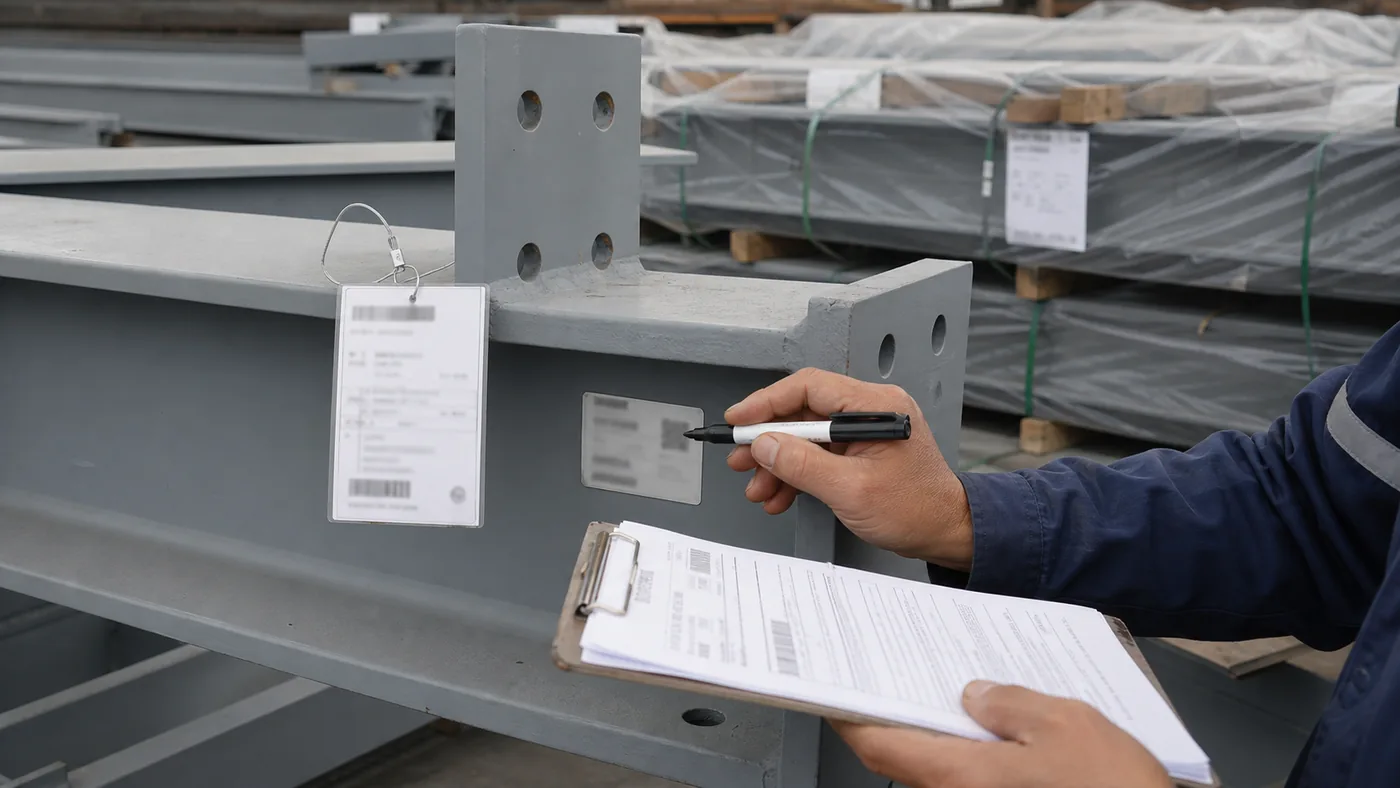
Steel structure component marking should let the site team identify each member, bundle, and small-parts package without guessing after unloading. EPC buyers should require a clear mark format that links the piece to drawings, grid or erection area, package number, shipment batch, and marking list. A usable marking system also needs readable labels after coating and transport, supporting photo evidence before shipment, and matching references in the packing list so the receiving team can sort, check shortages, and release steel to installation areas quickly.
1. Use consistent piece marks
Each component should have a clear piece mark that matches the drawing and packing list. The mark should be readable after coating, handling, and transport. If labels may be damaged during shipment, use both painted marks and physical tags where appropriate.
2. Connect marks to drawings
The site team should be able to identify where each component belongs without guessing. Component marks should connect to drawing numbers, grid lines, floor levels, building zones, or erection areas.
3. Label bundles for unloading
| Label item | Purpose |
|---|---|
| Bundle number | Connects packed steel to the packing list. |
| Component range | Shows which marks are inside the bundle. |
| Area or sequence | Helps unload near the correct installation zone. |
| Weight and handling note | Supports safe lifting and unloading. |
4. Separate small parts
Bolts, clips, brackets, plates, and other small parts are easy to lose. They should be packed in marked boxes or bags and listed separately. For multi-building projects, small parts should be separated by area or shipment batch.
5. Use a marking list
A marking list should include component mark, quantity, drawing reference, bundle number, coating status, and shipment batch. It should match the packing list and be available to the site before the containers arrive.
6. Common marking problems
- Marks are painted over or hidden after packing.
- Bundle labels do not match packing lists.
- Small parts are mixed across different building areas.
- Component marks use a different system from the erection drawings.
- Shipment batches are not aligned with installation sequence.
7. Component marking code format
For export projects, the marking code should be simple enough for the fabrication shop, logistics team, and site crew to read without translation. EPC buyers should agree on the mark format before mass fabrication starts.
| Code element | Example control point |
|---|---|
| Building or area | Use a short area code so components for different workshops, warehouses, or pipe rack zones are not mixed. |
| Grid or erection zone | Connect each mark to grid lines, bay numbers, floor levels, or erection sequence zones. |
| Member type | Separate columns, beams, bracing, purlins, girts, stairs, platforms, handrails, and small plates. |
| Piece number | Keep a unique piece number that appears on drawings, packing lists, and bundle labels. |
| Shipment batch | Show batch or container reference when materials are delivered in several shipments. |
8. Marking list fields to check before shipment
A steel component marking list should be more than a name list. It should be usable for container receiving, laydown planning, erection material release, and shortage checks at site.
- Piece mark and member description.
- Quantity, length, weight, and coating status.
- Drawing number, revision, and grid location.
- Bundle number, package number, or box number.
- Container number or planned shipment batch.
- Installation area, floor level, or erection sequence.
- Remarks for fragile coating, special lifting, or matching assemblies.
9. Photo evidence for component marks
Before shipment, ask the supplier to provide photo evidence for a sample of primary steel, secondary steel, bundle labels, small-part boxes, and loaded containers. Photos should show both the mark and the physical component, not only a close-up of the label. This gives the site team a reference when packages are opened.
| Photo item | What the photo should prove |
|---|---|
| Painted piece mark | The mark is visible after coating and handling. |
| Bundle label | The bundle number matches the packing list and component range. |
| Small-part package | Bolts, clips, plates, and accessories are separated by area or mark group. |
| Container loading view | The loading sequence supports unloading and site sorting. |
| Damaged or unclear mark | Any unclear mark is corrected before shipment or recorded for site attention. |
10. Site receiving questions for marked components
When steel reaches the project site, receiving teams should check whether component marks still match the documents. Early verification reduces erection delays caused by misplaced bundles, mixed bolts, or missing members.
- Do the package numbers match the packing list?
- Are all primary members readable after unloading?
- Are secondary members and small parts separated by area?
- Can the site team connect each mark to the latest erection drawings?
- Are missing, duplicated, damaged, or unreadable marks recorded with photos?
Frequently asked questions
What should a steel structure component mark include?
A useful component mark should connect the member to the drawing, grid or erection area, piece number, shipment batch, and packing list. It should be readable after coating, loading, sea freight, and site unloading.
Why are bundle labels not enough for site installation?
Bundle labels help unloading, but site teams also need piece marks on individual members, a marking list, drawing references, and photos. Otherwise components can be mixed after bundles are opened.
When should component marking be checked?
Component marking should be checked before shipment, during loading photo review, and again during site receiving. Early checks make missing, duplicated, damaged, or unreadable marks easier to correct.
Buyer note
Before shipment, request photos of component marks, bundle labels, small-part packages, and container loading. These photos help the site team prepare unloading and sorting before the steel arrives.
Buyer follow-up questions
How should buyers use this page?
Use it as a practical review aid for steel structure component marking for site installation. The page helps the buyer confirm what must be checked, what evidence should be requested, and which follow-up actions should be closed before the package moves to the next procurement step.
When should this review happen?
Use it before packing is closed, before shipment release, and when site teams need clear receiving or handover evidence.
What evidence should be kept?
Keep the records that prove the decision, especially component marks, bundle labels, bolt boxes, packing lists, loading photos, shipping documents, receiving records, and closeout notes. Photos, comments, approvals, open issues, and closeout notes should stay linked to the relevant drawing, supplier reply, shipment, or handover record.
How to use this checklist
Check this buyer-side checklist against the contract, approved drawings, owner requirements, engineer instructions, and the current edition of every project-specified standard. See the editorial and source review process.