Buyer-focused answer
Quick answer for buyers
Bolt and small parts packing checklist for steel structure exports, covering labels, quantities, crates, photos, packing lists, and site handover checks.
Main question
What should EPC buyers check when using the bolt and small parts packing checklist for steel structure exports?
Quick answer
Bolt and small parts packing checklist for steel structure exports, covering labels, quantities, crates, photos, packing lists, and site handover checks.
When to use this page
Use it before packing is closed, before shipment release, or when the site team needs receiving and handover evidence.
What to verify
Define which small parts are included; Count bolts and accessories by usable group; Use packing labels that site teams can understand; Choose suitable boxes, bags, or crates
Related next step
Bolt and small parts packing checklist for steel structure exports is a narrow but important topic for EPC buyers. Large beams and columns are usually easy to see during loading, but missing bolts, washers, splice plates, clips, and connection accessories can stop installation after the shipment reaches site.
The purpose of this checklist is to help buyers define how small parts should be counted, packed, labelled, photographed, and documented before the container leaves the factory.
Detailed answer
Bolt and small parts packing should separate fasteners and loose accessories into traceable packages that the site team can count, identify, and release by erection area. EPC buyers should require labels with package number, item description, quantity, drawing or area reference, and supporting photos before loading. The final packing file should also separate bolts, nuts, washers, clips, and small plates from main steel members so shortages can be found before shipment release instead of after the installation team opens mixed boxes at site.
When the package count is confirmed, the next control point is sequence. Use the steel structure bolt packing sequence checklist to align each bolt box with erection area, release batch, and receiving order instead of sending mixed packages that the site team has to sort again.
1. Define which small parts are included
The RFQ and packing instruction should separate loose accessories from main steel members. If the supplier only provides one general packing list, the site team may not know which small items belong to each building area or connection type.
| Item group | Examples to list |
|---|---|
| Fasteners | High-strength bolts, ordinary bolts, nuts, washers, anchor bolts, and spare bolts. |
| Connection parts | Splice plates, gusset plates, clips, brackets, shim plates, and small stiffeners. |
| Installation accessories | Touch-up material, labels, temporary parts, alignment items, or special tools if supplied. |
| Documentation items | Packing list, bolt list, accessory list, inspection photos, and container loading photos. |
2. Count bolts and accessories by usable group
Counting only the total number of bolts is not enough. The packing list should show bolt size, grade, length, quantity, drawing reference, and intended area if possible.
- Separate bolts by size, grade, length, and surface finish.
- Match bolt groups to connection drawings or erection areas.
- List nuts and washers separately when quantities differ.
- Show whether spare bolts are included and how they are labelled.
- Record any special fasteners that cannot be easily replaced locally.
This small-parts list should support the wider export packing checklist for steel structure components.
3. Use packing labels that site teams can understand
Labels should be readable after sea freight, unloading, and outdoor storage. A label that works inside the factory may fail after moisture, abrasion, or rough handling.
| Label field | Why it matters |
|---|---|
| Project or PO number | Prevents confusion when multiple projects are loaded close together. |
| Package number | Connects the box, crate, or bag to the packing list. |
| Item description | Shows bolt size, plate type, accessory name, or related component group. |
| Quantity | Allows receiving teams to check shortage quickly. |
| Drawing or area reference | Helps the site team place small parts near the correct erection zone. |
4. Choose suitable boxes, bags, or crates
Small parts should be packed to prevent loss, water damage, mixing, and crushing. Heavy bolts in weak cartons can break open during handling. Thin plates and clips can damage painted components if packed loose.
- Use strong boxes, crates, drums, or bags suitable for export handling.
- Keep heavy fasteners in manageable package weights.
- Separate coated, galvanized, and bare items if surface condition matters.
- Use inner bags or dividers when several item types share one crate.
- Protect sharp plates or clips so they do not scratch coated steel members.
5. Link small parts to component marking
Small parts should not be treated as anonymous accessories. They should connect to component marks, erection areas, or drawing references so the receiving team can sort them efficiently.
For larger member identification, use the guide on steel structure component marking for site installation. The same logic should apply to small parts: every package needs a clear relationship to the drawings or installation sequence.
6. Take photos before and during loading
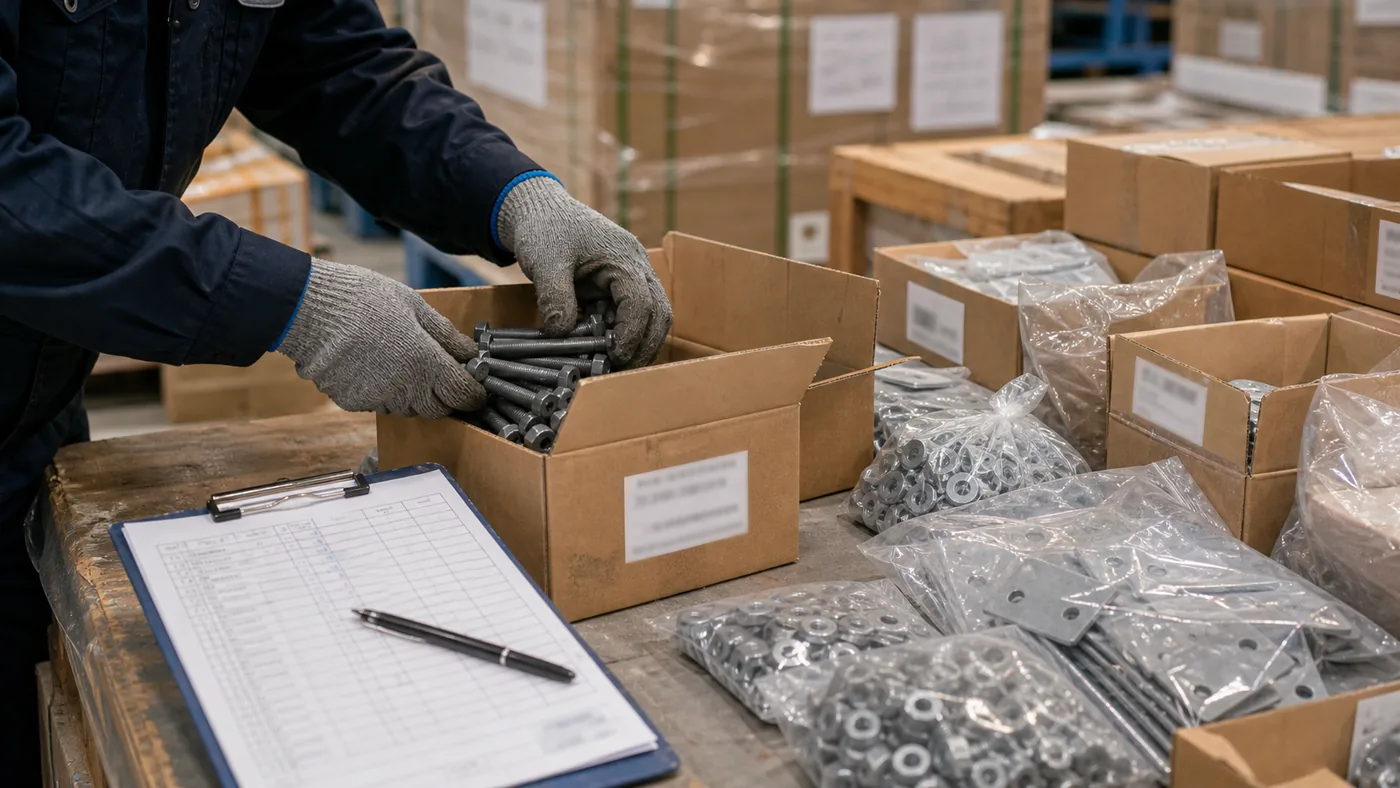
Photo evidence helps resolve shortages and damage claims. Photos should show the contents before closing the package, the external labels, the package condition, and the final container loading position.
| Photo type | What it should show |
|---|---|
| Open package photo | Contents, separated groups, and visible item labels before sealing. |
| Closed package photo | External label, package number, and general condition. |
| Container loading photo | Where the package is loaded and whether it is protected from heavy members. |
| Final seal photo | Container number and seal number if required by the shipment record. |
7. Review the small-parts packing list before release
The final packing list should be reviewed before shipment release, not after the vessel departs. Ask the supplier to submit a package index that separates large steel members from bolts and loose accessories.
- Package number, item name, specification, quantity, and weight.
- Related drawing number, component mark, or building area.
- Photo reference for each critical package.
- Container number or shipment batch.
- Receiving note for the site team if packages must be opened in sequence.
For the final document review, compare the package index with the pre-shipment inspection document checklist.
8. Bolt packing sequence for erection areas
For large export projects, bolt packages should follow the erection area or shipment sequence instead of being packed only by total bolt type. This reduces the time site teams spend opening boxes and searching for fasteners during the first installation stage.
| Packing sequence item | Control point for EPC buyers |
|---|---|
| First erection area | Confirm the first steel area has a clearly marked bolt package that can be unloaded and opened first. |
| Connection type | Separate anchor bolts, splice bolts, bracing bolts, purlin bolts, and special fasteners when practical. |
| Container or batch | Match small-part packages to the same shipment batch as the related steel components. |
| Spare fasteners | Label spare bolts separately so they are not mistaken for required connection quantities. |
| Critical connections | Identify special bolts, oversized holes, or non-standard washers that cannot be sourced locally. |
9. Shortage reconciliation before shipment
Before loading, the supplier should reconcile the bolt list, packing list, and package photos. This is especially important when bolts are packed by subcontracted logistics teams or when several buildings are shipped together.
- Compare bolt quantities against the latest erection drawings and connection schedule.
- Check that each box, crate, or bag has a package number that appears in the packing list.
- Confirm that nuts, washers, and spare parts are counted separately from bolts.
- Record any quantity adjustment caused by design revision or drawing change.
- Ask the supplier to sign off the final small-parts reconciliation before shipment release.
10. Site handover checks for bolt packages
Small-parts control should continue after arrival. The site team should verify package counts before boxes are moved across the laydown area. If shortages are found later, it becomes harder to prove whether the issue happened during packing, shipping, unloading, or site storage.
Before site handover, match the packing records against the steel structure shipping documents checklist for EPC projects so the bolt list, packing list, package photos, and receiving forms all describe the same boxes and batch references.
| Site check | Evidence to keep |
|---|---|
| Package count | Receiving record showing package numbers compared with the packing list. |
| External label condition | Photos of labels before boxes are opened or moved. |
| Damaged package | Photo evidence, container location, and immediate shortage check. |
| Area sorting | Record showing which bolt packages were released to each erection area. |
| Open shortage | Issue log with item specification, quantity, drawing reference, and closeout action. |
Red flags before shipment
- Bolts are listed only as a total weight without size or quantity.
- Different bolt grades or lengths are mixed in one unlabelled bag.
- Small plates and clips are loaded loose inside a bundle.
- Package labels do not match the packing list.
- Photos show boxes placed under heavy steel members without protection.
- The supplier cannot explain which package supports which erection area.
Frequently asked questions
How should bolts be packed for steel structure export projects?
Bolts should be separated by size, grade, length, finish, drawing reference, and erection area where practical. Each box or crate should have a package number, quantity record, label, and photo evidence before loading.
Why should small parts be separated from main steel members?
Small parts are easy to lose or mix during loading and site sorting. Separating bolts, nuts, washers, clips, plates, and accessories by package and erection area helps the receiving team find shortages early.
What evidence should be kept for bolt and small-parts packing?
Keep the small-parts packing list, bolt list, package labels, open-package photos, closed-package photos, container loading photos, and any shortage reconciliation signed before shipment release.
Buyer note
Small parts control is a low-cost step that prevents expensive site delays. Define bolt and accessory packing rules in the RFQ, check the small-parts packing list before shipment, and keep the photo record with the final quality and delivery documents.
Buyer follow-up questions
How should buyers use this page?
Use it as a practical review aid for bolt and small parts packing checklist for steel structure exports. The page helps the buyer confirm what must be checked, what evidence should be requested, and which follow-up actions should be closed before the package moves to the next procurement step.
When should this review happen?
Use it before packing is closed, before shipment release, and when site teams need clear receiving or handover evidence.
What evidence should be kept?
Keep the records that prove the decision, especially component marks, bundle labels, bolt boxes, packing lists, loading photos, shipping documents, receiving records, and closeout notes. Photos, comments, approvals, open issues, and closeout notes should stay linked to the relevant drawing, supplier reply, shipment, or handover record.
How to use this checklist
Check this buyer-side checklist against the contract, approved drawings, owner requirements, engineer instructions, and the current edition of every project-specified standard. See the editorial and source review process.