Buyer-focused answer
Quick answer for buyers
Steel structure factory audit welding equipment checklist for EPC buyers reviewing machines, calibration, fixtures, records, and maintenance evidence.
Main question
What should EPC buyers check when using the steel structure factory audit welding equipment checklist?
Quick answer
Steel structure factory audit welding equipment checklist for EPC buyers reviewing machines, calibration, fixtures, records, and maintenance evidence.
When to use this page
Use it before supplier award, during factory audit planning, or when schedule risk needs evidence beyond supplier claims.
What to verify
Confirm welding process coverage; Check machine capacity and condition; Review calibration and verification records; Confirm fixtures, positioners, and handling equipment
Related next step
A steel structure factory audit welding equipment checklist helps EPC buyers look beyond a simple equipment list. Many workshops can show welding machines, but the buyer needs to know whether those machines are suitable for the member size, weld type, inspection level, production schedule, and documentation requirements of the project.
This checklist is designed for buyer-side factory visits, remote supplier audits, and pre-award technical reviews. It supports structural steel buildings, industrial workshops, logistics warehouses, platforms, pipe racks, and other fabricated steel packages where welding quality and production reliability matter.
1. Confirm welding process coverage
Start by matching the factory's welding process capability to the project specification. Do not only count machines. Check whether the available processes match the joint types, material thickness, welding positions, and inspection requirements in the RFQ.
| Process area | Audit question |
|---|---|
| Manual or semi-automatic welding | Are the machines suitable for the expected fillet welds, repair welds, and site-sensitive details? |
| Submerged arc welding | Is equipment available for long beam or column welds where high deposition rate is required? |
| Stud or special welding | Are special welding machines available if the project includes shear studs, embedded parts, or accessories? |
| Repair welding | Are repair areas controlled with approved procedures, qualified welders, and traceable inspection records? |
2. Check machine capacity and condition
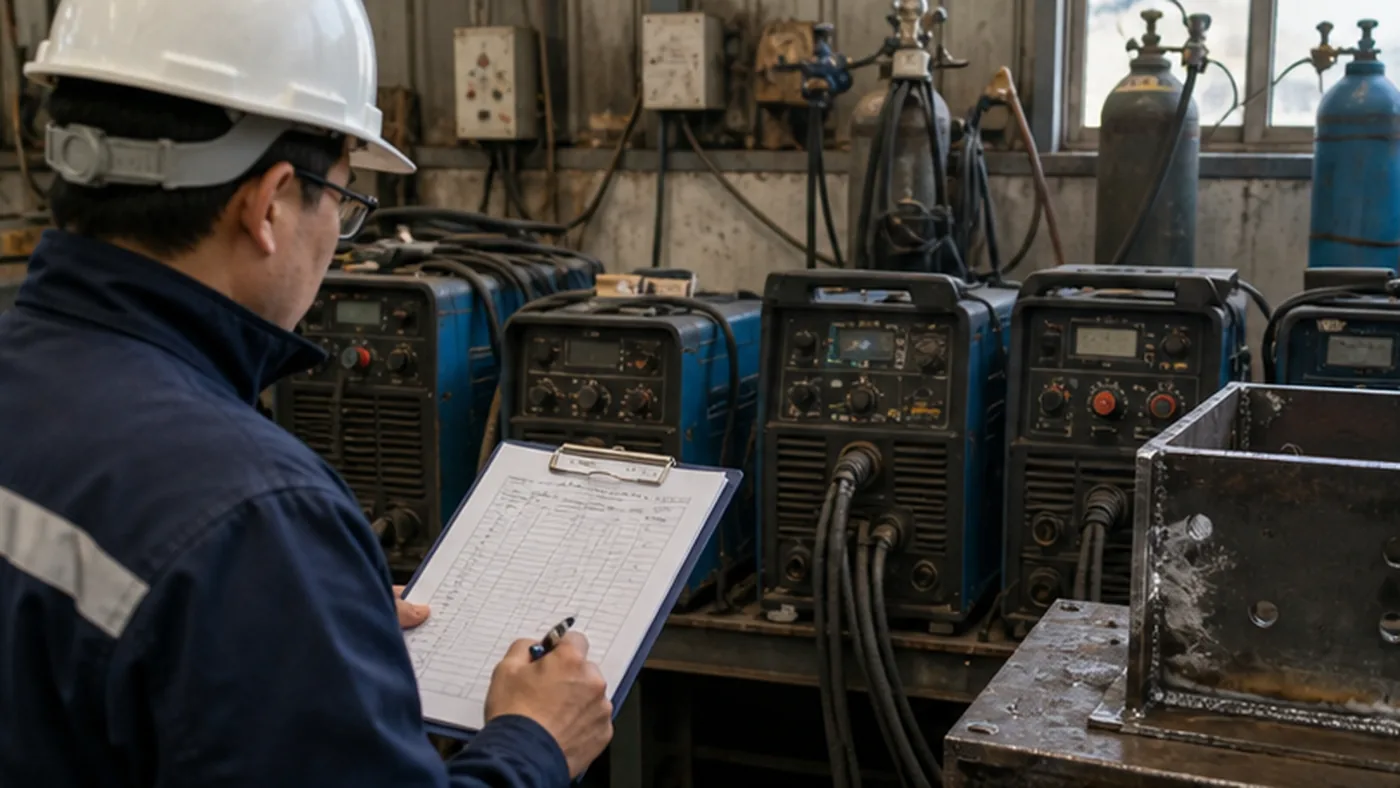
A machine may be present but unsuitable for the required duty cycle or member size. Review capacity plates, machine age, actual operating condition, cable condition, torch condition, grounding, and spare-machine availability.
- Machine model, rated current, duty cycle, and welding process range.
- Condition of wire feeders, torches, regulators, cables, clamps, and grounding points.
- Availability of backup machines for schedule-critical work.
- Evidence that machines are used in regular production, not only displayed for audit.
- Safe separation of welding areas from painting, packing, and finished component storage.
For overall capacity context, compare equipment findings with the steel structure production capacity checklist.
3. Review calibration and verification records
Calibration control should be practical and traceable. Buyers do not need a perfect binder of paperwork; they need evidence that welding parameters and related measuring tools are controlled enough for the project requirement.
| Record | What to verify |
|---|---|
| Machine verification | Check whether current, voltage, wire feed, and display accuracy are verified at defined intervals. |
| Measuring tools | Confirm weld gauges, temperature crayons, coating gauges, and dimensional tools have valid records. |
| Parameter records | Review whether production weld settings can be linked to WPS requirements. |
| Out-of-tolerance action | Ask what happens when a machine or tool fails verification. |
4. Confirm fixtures, positioners, and handling equipment
Welding quality depends on fit-up and handling, not only on the welding machine. Poor fixtures can create distortion, uneven gaps, difficult welding positions, and repeated correction work.
- Assembly beds and fixtures fit the beam, column, truss, or frame size.
- Positioners, rollers, or turning equipment are available for heavy or awkward members.
- Lifting equipment can move partly welded members without unsafe distortion.
- Temporary supports and clamps are controlled, not improvised for every assembly.
- Fit-up inspection is performed before major welds begin.
5. Check consumable storage and traceability
Welding consumables should be suitable, dry, identified, and traceable when required. EPC buyers should verify storage conditions and whether the factory can connect consumable batches to production records.
| Consumable item | Audit point |
|---|---|
| Welding wire | Grade, batch number, storage condition, and issue control are visible. |
| Electrodes | Drying, holding, exposure time, and return control are defined where applicable. |
| Flux | Storage, recycling, drying, and contamination control are checked for submerged arc welding. |
| Shielding gas | Gas type, cylinder identification, regulator condition, and flow control are reviewed. |
6. Connect equipment to welder qualification
Equipment is only useful when qualified people use it under controlled procedures. Ask how the factory assigns welders to process, position, material thickness, and inspection class.
- Welder certificates match the process and position required by the project.
- WPS documents are available at the work area or controlled through production documents.
- Supervisors understand which welds need higher inspection attention.
- Repair welds are performed by approved personnel under controlled instructions.
- Production records can connect welder, machine, WPS, and inspection result.
For quality-document expectations, use the welding quality requirements guide.
7. Review maintenance and downtime evidence
Maintenance records help buyers understand whether production risk is hidden. If key machines frequently fail or have no maintenance plan, the quoted schedule may be unrealistic.
- Preventive maintenance plan for major welding machines and wire feeders.
- Recent breakdown records and repair actions.
- Spare parts availability for common machine failures.
- Operator checks before production starts.
- Escalation method when equipment failure affects schedule or inspection quality.
Red flags during the audit
- The factory cannot explain which welding machines will be used for the project.
- Machines are present but cables, torches, regulators, or grounding are in poor condition.
- Calibration or verification records are missing for key machines and measuring tools.
- WPS documents exist in the office but are not used at the work area.
- Consumables are stored without clear grade, batch, drying, or issue control.
- Maintenance records show repeated breakdowns with no corrective action.
Buyer note
The purpose of this audit is not to reject a factory because one machine is old. The purpose is to understand whether the welding equipment system can support the project requirement. A good audit connects machines, fixtures, consumables, welder qualification, inspection records, and schedule risk into one practical decision.
Buyer follow-up questions
How should buyers use this page?
Use it as a practical review aid for steel structure factory audit welding equipment checklist. The page helps the buyer confirm what must be checked, what evidence should be requested, and which follow-up actions should be closed before the package moves to the next procurement step.
When should this review happen?
Use it before awarding a large package or when the buyer needs evidence that the fabricator can actually deliver the promised scope and schedule.
What evidence should be kept?
Keep the records that prove the decision, especially workshop flow, monthly output evidence, equipment checks, welding and coating controls, inspection records, and subcontracted work limits. Photos, comments, approvals, open issues, and closeout notes should stay linked to the relevant drawing, supplier reply, shipment, or handover record.
How to use this checklist
Check this buyer-side checklist against the contract, approved drawings, owner requirements, engineer instructions, and the current edition of every project-specified standard. See the editorial and source review process.