Buyer-focused answer
Quick answer for buyers
Welding quality requirements for steel structure fabrication, including WPS, welder qualification, visual inspection, NDT, repairs, and records.
Main question
What should EPC buyers check when using the welding quality requirements for steel structure fabrication?
Quick answer
Welding quality requirements for steel structure fabrication, including WPS, welder qualification, visual inspection, NDT, repairs, and records.
When to use this page
Use it before fabrication release, before shipment, or before final handover when missing records can delay acceptance.
What to verify
State the welding standard and acceptance level; Ask for WPS and procedure control; Verify welder qualification; Define in-process welding inspection
Related next step
Welding quality requirements for steel structure fabrication should be included in the RFQ, not left until final inspection. For EPC buyers, welding quality affects structural acceptance, owner review, handover documentation, and site confidence in the fabricated components.
This guide explains what procurement teams should ask before awarding a fabrication package. It is not a replacement for project engineering specifications, but it helps buyers request the right welding evidence from shortlisted fabricators.
1. State the welding standard and acceptance level
Every RFQ should identify the welding standard or project specification that controls the work. If the standard is not stated, suppliers may quote different inspection levels and repair assumptions.
- Applicable welding code or owner specification.
- Weld type and critical weld categories.
- Visual inspection criteria.
- NDT method and percentage, if required.
- Repair acceptance and re-inspection rules.
2. Ask for WPS and procedure control
A welding procedure specification, often called WPS, defines how welding is performed. EPC buyers should ask whether the fabricator has qualified procedures for the material grade, thickness range, welding process, joint type, and position required by the project.
| WPS item | Buyer question |
|---|---|
| Material range | Does the procedure cover the steel grade and thickness used in the project? |
| Welding process | Which process is used for shop welding and which is used for repair welding? |
| Consumables | Are welding consumables controlled, stored, and traceable? |
| Preheat and interpass | Are preheat, interpass temperature, and heat input requirements defined? |
3. Verify welder qualification
Welder qualification records should match the type of welding being performed. A certificate is useful only if it covers the welding process, position, material group, and thickness range required by the project.
- Check certificate validity dates.
- Confirm the welding process and position covered.
- Confirm thickness and material range.
- Ask how the factory assigns qualified welders to project work.
4. Define in-process welding inspection
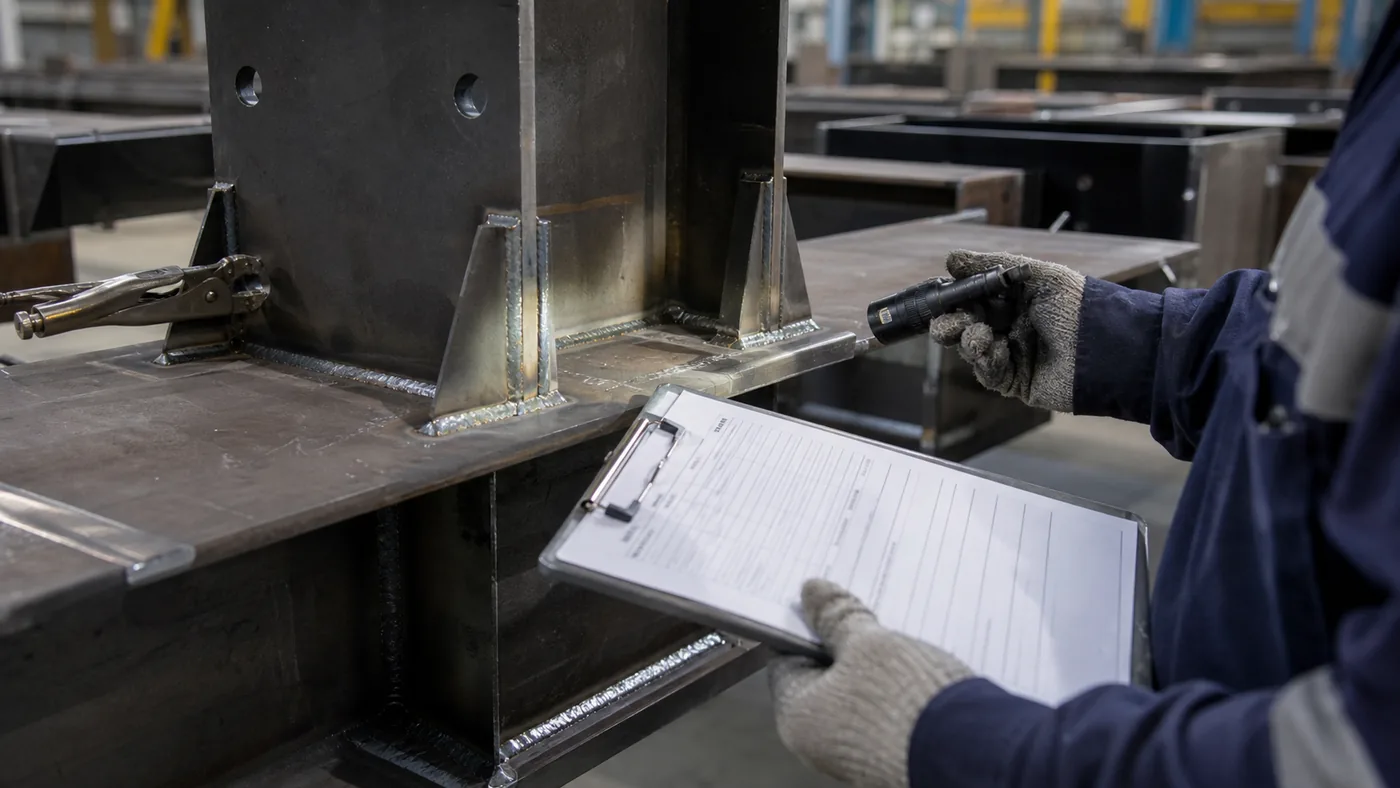
Welding quality should be controlled before final inspection. Buyers should ask how the fabricator checks fit-up, bevel preparation, tack welding, root passes, weld size, distortion, and repair areas during production.
| Inspection point | What to verify |
|---|---|
| Fit-up before welding | Gap, alignment, bevel, tack welds, and drawing compliance. |
| During welding | WPS use, consumable control, sequence, temperature, and distortion control. |
| After welding | Weld size, appearance, undercut, porosity, cracks, spatter, and repairs. |
| Before coating | All required welding inspection and repair records are complete. |
5. Specify NDT requirements clearly
If non-destructive testing is required, define it before quotation. The RFQ should state the method, percentage, weld categories, acceptance standard, reporting format, and responsibility for third-party inspection costs.
- Ultrasonic testing, magnetic particle testing, dye penetrant testing, or radiographic testing if required.
- Which welds or structural zones require testing.
- Testing percentage and sampling method.
- Who selects the tested welds.
- Report language, format, and review process.
6. Control welding repairs
Repair rules should be defined before production. Ask how non-conforming welds are reported, repaired, re-inspected, and recorded. Repair welding should follow an approved method and should not be hidden before coating.
| Repair control | Required evidence |
|---|---|
| Non-conformance record | Location, component mark, defect type, and inspector decision. |
| Repair method | Approved grinding, gouging, rewelding, or other repair instruction. |
| Re-inspection | Visual inspection and NDT repeat check if required. |
| Document closeout | Repair record signed and linked to the component mark. |
7. Request welding records in the document package
The welding document package should connect the project specification, welder qualification, inspection records, NDT reports, and repair records. EPC buyers should define the document list in the RFQ and ask suppliers to confirm which records are included by default.
- WPS or welding procedure list.
- Welder qualification records.
- Welding consumable certificates or batch records, if required.
- Fit-up and visual inspection reports.
- NDT reports and tested weld map, if required.
- Non-conformance and repair records.
For the full project file, use the steel structure quality documents checklist.
8. Red flags during supplier review
- The supplier cannot provide sample welding inspection records.
- Welder certificates do not match the project welding process or thickness range.
- The supplier treats NDT as an optional cost after award.
- Repair records are not linked to component marks.
- Welding records are prepared only after the buyer asks near shipment.
Buyer note
Welding quality is easier to control before production than after components are painted and packed. Include welding requirements in the RFQ, compare suppliers by evidence, and request sample records before awarding a large steel structure package.
Buyer follow-up questions
How should buyers use this page?
Use it as a practical review aid for welding quality requirements for steel structure fabrication. The page helps the buyer confirm what must be checked, what evidence should be requested, and which follow-up actions should be closed before the package moves to the next procurement step.
When should this review happen?
Use it before shipment release, final document turnover, or owner handover when traceability and acceptance records need to be closed.
What evidence should be kept?
Keep the records that prove the decision, especially certificates, heat numbers, inspection records, NCR closure, coating reports, signatures, revisions, and final handover files. Photos, comments, approvals, open issues, and closeout notes should stay linked to the relevant drawing, supplier reply, shipment, or handover record.
How to use this checklist
Check this buyer-side checklist against the contract, approved drawings, owner requirements, engineer instructions, and the current edition of every project-specified standard. See the editorial and source review process.