Buyer-focused answer
Quick answer for buyers
Steel structure anchor bolt delivery checklist for export projects: sizes, grades, nuts, washers, templates, labels, packing, and receiving evidence.
Main question
What should EPC buyers check when using the steel structure anchor bolt delivery checklist for export projects?
Quick answer
Steel structure anchor bolt delivery checklist for export projects: sizes, grades, nuts, washers, templates, labels, packing, and receiving evidence.
When to use this page
Use it before packing is closed, before shipment release, or when the site team needs receiving and handover evidence.
What to verify
Confirm the anchor bolt schedule; Check drawings and revisions before packing; Separate bolts by size, grade, and installation area; Protect threads and coated surfaces
Related next step
A steel structure anchor bolt delivery checklist for export projects helps EPC teams avoid one of the most expensive small-part problems: bolts, templates, nuts, or washers arriving late, mixed, damaged, or without enough identification. Anchor bolts are often needed before the main steel frame arrives, so a small delivery error can affect foundation work, column setting, and the first erection sequence.
This checklist is written for buyers, logistics coordinators, and site teams handling exported steel structure packages. It focuses on delivery control and receiving evidence rather than anchor bolt design.
1. Confirm the anchor bolt schedule
The delivery package should include a clear anchor bolt schedule. This schedule should connect each bolt type to the drawing, grid location, base plate, template, nut, washer, finish, and quantity. If the schedule is missing or vague, the site team may not know which bolts belong to each foundation group.
- Bolt diameter, length, thread length, hook or plate detail, and grade.
- Nut and washer type, quantity, grade, and coating requirement.
- Template plate or setting frame reference, if supplied.
- Grid line, column mark, base plate mark, or installation area.
- Drawing number and revision that define the anchor bolt group.
2. Check drawings and revisions before packing
Anchor bolt errors often come from revision gaps. The delivery checklist should confirm that bolt lists, templates, packing labels, and foundation drawings use the same revision. A correct bolt made to an old drawing can still be a serious site problem.
| Revision check | Why it matters |
|---|---|
| Anchor bolt plan | Confirms the bolt group matches current grid and column layout. |
| Base plate drawing | Confirms hole pattern, washer size, and projection requirement. |
| Template drawing | Confirms setting template holes match bolt group and column mark. |
| Packing label | Prevents old drawing references from reaching the site package. |
For revision control, use the fabrication drawing revision control checklist.
3. Separate bolts by size, grade, and installation area
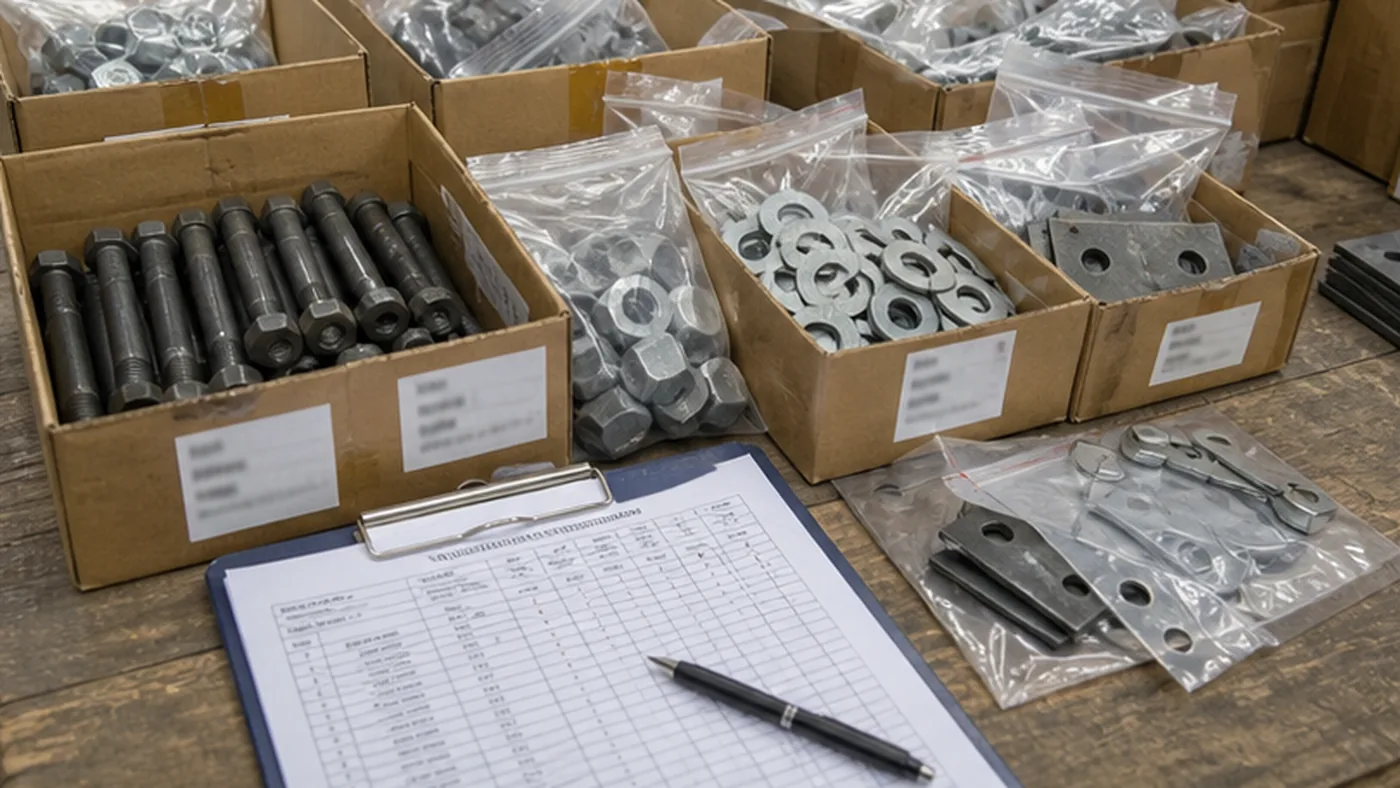
Anchor bolts should not be packed as one mixed pile. The package should separate different diameters, grades, lengths, templates, and installation zones. Each box, crate, or bundle should have a visible label that matches the packing list.
- Separate bolts by diameter and length.
- Separate different grades or coating finishes.
- Bundle or box bolts by grid area, column group, or foundation phase where practical.
- Pack nuts and washers with matching bolt groups or list them separately.
- Use durable labels on the outside and inside the package.
For wider small-part control, compare this package with the bolt and small parts packing checklist.
4. Protect threads and coated surfaces
Damaged threads can delay installation even when the bolt count is correct. Before shipment, check whether threads are protected from impact, corrosion, coating build-up, and abrasion. If bolts are galvanized or coated, confirm the finish does not prevent nuts from fitting correctly.
| Protection item | Buyer check |
|---|---|
| Thread protection | Caps, wrapping, sleeves, or other protection used where required. |
| Nut fit check | Sample nuts tested on supplied bolts after coating or galvanizing. |
| Corrosion protection | Packaging prevents standing water and direct exposure during transport. |
| Handling protection | Bolts are not loose in a crate where threads can be damaged by impact. |
5. Verify templates and setting accessories
Templates, setting frames, nuts, washers, and special accessories should be checked as part of the same delivery package. If templates are shipped separately from the bolts, both packages should carry matching labels and drawing references.
- Template mark matches the column, grid, or anchor bolt group.
- Template hole pattern and hole size match the current drawing.
- Top nuts, bottom nuts, washers, and levelling accessories are listed.
- Templates are protected from bending during transport.
- Installation notes or setting height references are included when required.
6. Prepare delivery documents and photo evidence
Anchor bolt packages should have enough documentation for customs, warehouse receiving, and site installation. Photos should show labels and package contents before the crate is closed or wrapped.
| Document or photo | Purpose |
|---|---|
| Packing list | Shows bolt size, quantity, package number, weight, and installation area. |
| Marking list | Connects bolt groups and templates to drawings and grid locations. |
| Material or coating record | Supports grade, finish, or project quality requirements. |
| Packing photos | Shows package labels, contents, thread protection, and crate condition. |
For final file review, use the shipping documents checklist.
7. Check shipment timing
Anchor bolts often need to arrive before main steel members because foundation work may start earlier. The delivery plan should confirm whether anchor bolts are shipped as an early package, with the first steel shipment, or inside a mixed small-parts package.
- Identify anchor bolts as early-site items if foundation work needs them first.
- Avoid hiding anchor bolt crates inside unrelated steel bundles.
- Send packing and label photos to the site team before arrival.
- Confirm the receiving team knows which packages must be checked first.
If anchor bolts travel inside a wider fastener shipment, keep the package order aligned with the steel structure bolt packing sequence checklist so first-use areas are not blocked by mixed boxes. The same shipment should also be checked against the steel structure unloading checklist before crates are opened or moved at site.
8. Site receiving checks
When the anchor bolts arrive, the receiving team should check package labels before opening everything. Any shortage, wrong size, damaged thread, missing nut, or missing template should be reported immediately with photos.
- Count packages against the packing list.
- Check bolt sizes, lengths, and labels against the anchor bolt schedule.
- Confirm nuts and washers are present and separated correctly.
- Inspect threads, coating, galvanizing, and template condition.
- Record shortage or damage with package number, photos, and receiving date.
For site reporting, use the steel structure receiving checklist and include anchor bolt issues in the installation package checklist.
Red flags before delivery release
- The anchor bolt list does not show drawing revision or column/grid reference.
- Different bolt sizes are packed together without internal labels.
- Nuts and washers are counted only as total weight, not by size and group.
- Templates are not labelled to match the bolt group.
- Photos do not show package labels or thread protection.
- The delivery plan ships anchor bolts too late for foundation work.
Buyer note
Anchor bolts are small compared with columns and beams, but they control the start of site erection. A focused delivery checklist helps EPC teams protect early-site schedule, reduce missing-part disputes, and give the foundation team the information needed before steel frame installation begins.
Buyer follow-up questions
How should buyers use this page?
Use it as a practical review aid for steel structure anchor bolt delivery checklist for export projects. The page helps the buyer confirm what must be checked, what evidence should be requested, and which follow-up actions should be closed before the package moves to the next procurement step.
When should this review happen?
Use it before packing is closed, before shipment release, and when site teams need clear receiving or handover evidence.
What evidence should be kept?
Keep the records that prove the decision, especially component marks, bundle labels, bolt boxes, packing lists, loading photos, shipping documents, receiving records, and closeout notes. Photos, comments, approvals, open issues, and closeout notes should stay linked to the relevant drawing, supplier reply, shipment, or handover record.
How to use this checklist
Check this buyer-side checklist against the contract, approved drawings, owner requirements, engineer instructions, and the current edition of every project-specified standard. See the editorial and source review process.