Buyer-focused answer
Quick answer for buyers
Steel structure bolt issue report checklist at site: record missing bolts, wrong sizes, damaged threads, hole mismatch, tightening records, and closeout.
Main question
What should EPC buyers check when using the steel structure bolt issue report checklist at site?
Quick answer
Steel structure bolt issue report checklist at site: record missing bolts, wrong sizes, damaged threads, hole mismatch, tightening records, and closeout.
When to use this page
Use it before packing is closed, before shipment release, or when the site team needs receiving and handover evidence.
What to verify
Identify the affected bolt set; Classify the bolt issue; Check whether the issue is packing, site sorting, or fabrication; Collect photos and measurement evidence
Related next step
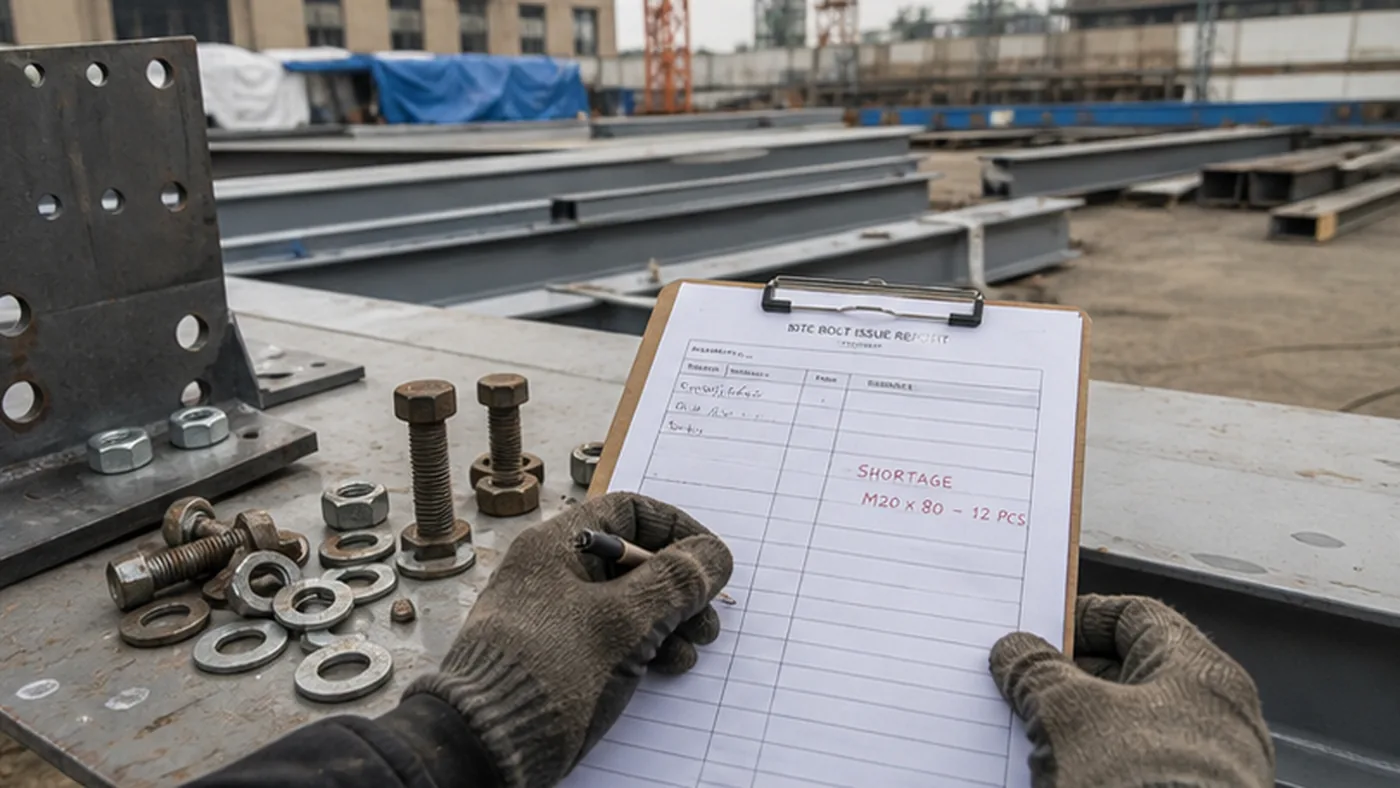
A steel structure bolt issue report checklist at site helps EPC teams handle bolt problems before they become installation delays or quality disputes. Bolt issues are often discovered after packages are opened, members are lifted, or the erection crew starts fitting connections.
This checklist is written for site engineers, receiving teams, installation supervisors, project buyers, and quality inspectors. It focuses on practical reporting: what happened, which bolt set is affected, what evidence is available, and what action is required before the connection can be released.
1. Identify the affected bolt set
Every bolt issue report should identify the bolt set clearly. A report that only says "bolts wrong" does not help the supplier, buyer, or site team decide whether the problem is packing, ordering, site sorting, or fabrication alignment.
- Project name, area, grid line, drawing number, and connection location.
- Bolt grade, diameter, length, nut type, washer type, and coating or galvanizing requirement.
- Bolt box number, package number, bolt list reference, and shipment batch.
- Quantity required, quantity received, quantity installed, and quantity affected.
- Report date, responsible site person, and installation status.
For delivery and package confirmation, compare with the bolt and small parts packing checklist.
2. Classify the bolt issue
Different bolt problems need different closeout actions. Some issues can be solved by site sorting, while others require replacement, engineering approval, or a hold on installation.
| Issue type | What to record |
|---|---|
| Missing bolts | Short quantity, expected box number, received quantity, and affected connections. |
| Wrong bolt size | Required size, supplied size, bolt list reference, and connection impact. |
| Wrong grade or coating | Required grade, marking on bolt head, certificate reference, and corrosion requirement. |
| Damaged threads or nuts | Thread condition, quantity affected, package condition, and whether damage happened before use. |
| Hole mismatch | Connection mark, hole diameter, measured offset, and whether reaming or correction is proposed. |
| Tightening or torque issue | Method, tool calibration, inspection record, and failed connection details. |
3. Check whether the issue is packing, site sorting, or fabrication
Before assigning responsibility, the report should separate bolt packing issues from site handling problems and connection fabrication problems. This keeps the report useful and reduces unnecessary disputes.
- Check whether the correct bolt box was opened for the related erection area.
- Compare bolt list quantities with the packing list and receiving record.
- Confirm whether bolts from different areas were mixed during site storage.
- Inspect package labels, bolt head markings, and certificates.
- Measure hole alignment before concluding that the bolt itself is wrong.
For site storage controls, use the site storage checklist.
4. Collect photos and measurement evidence
Photos should prove both the bolt condition and the project context. A close-up of a bolt is rarely enough unless it is connected to a box label, bolt list, drawing, or connection mark.
- Photo of the bolt box label, package number, or bundle label.
- Photo of bolt head marking, nut marking, washer type, or coating condition.
- Photo of the affected connection mark and drawing reference.
- Measurement photo for bolt length, diameter, thread length, or hole offset.
- Photo of damaged threads, missing washers, mixed bolts, or broken packaging.
- Photo file names linked to the issue report number.
5. Decide whether installation must be held
The most important site decision is whether the affected connection can continue. The report should state clearly whether the connection is released, conditionally accepted, or held until correction.
| Condition | Suggested control |
|---|---|
| Bolts missing but connection not yet required | Track replacement date and protect installation sequence. |
| Wrong grade or unknown grade | Hold installation until certificate and marking are confirmed. |
| Wrong size or short thread engagement | Hold connection and request engineering or supplier confirmation. |
| Minor accessory shortage | Use approved replacement only if grade, coating, and quantity are controlled. |
| Hole mismatch | Hold field modification until approved correction method is issued. |
6. Define the corrective action
A bolt issue report should move from observation to action. The action may be site sorting, supplier replacement, local purchase, engineering approval, rework, or update of the bolt list.
- Search and re-sort bolt boxes if site mixing is possible.
- Request replacement bolts when shortage or wrong specification is confirmed.
- Use local purchase only with approved grade, dimensions, coating, and certification.
- Request engineering approval before reaming holes, changing bolt size, or modifying plates.
- Update the bolt list, receiving record, or installation package if document errors caused confusion.
If the problem is related to confirmed shortages, connect the issue to the missing parts report checklist.
7. Track tightening and inspection records
For high-strength or controlled bolting work, the report should include tightening and inspection references. This is especially important when the issue involves torque, pretension, calibration, or repeated rejection.
- Tightening method and required inspection standard.
- Tool calibration record and calibration date.
- Inspection person, inspection date, and connection area.
- Rejected bolt group, reason for rejection, and rework method.
- Final acceptance record after correction.
8. Close the bolt issue report
The issue should be closed only when the site has evidence that the connection is ready for installation or has been corrected. Email confirmation without site evidence is not enough for a strong closeout record.
- Replacement receiving photos and quantity check.
- Certificate, bolt marking, and coating confirmation where required.
- Engineering approval for modification or substitution.
- Updated installation package or bolt list.
- Final inspection record, closeout date, and responsible person.
When corrected bolts are issued for erection, attach the closeout record to the installation package checklist.
Red flags in bolt issue reports
- The report does not identify bolt grade, diameter, length, or affected connection.
- Site teams replace bolts locally without approval or certificate control.
- Hole mismatch is treated as a bolt supply issue without measurement evidence.
- Mixed bolt boxes are not checked before a supplier claim is opened.
- The report does not state whether installation is released or held.
- Tightening problems are closed without calibration or inspection records.
Buyer note
Bolt issues are small in size but can stop erection, delay inspection, or create quality disputes. EPC buyers should require site teams to report bolt issues with exact specification, package evidence, affected connection, installation impact, and documented closeout.
Buyer follow-up questions
How should buyers use this page?
Use it as a practical review aid for steel structure bolt issue report checklist at site. The page helps the buyer confirm what must be checked, what evidence should be requested, and which follow-up actions should be closed before the package moves to the next procurement step.
When should this review happen?
Use it before packing is closed, before shipment release, and when site teams need clear receiving or handover evidence.
What evidence should be kept?
Keep the records that prove the decision, especially component marks, bundle labels, bolt boxes, packing lists, loading photos, shipping documents, receiving records, and closeout notes. Photos, comments, approvals, open issues, and closeout notes should stay linked to the relevant drawing, supplier reply, shipment, or handover record.
How to use this checklist
Check this buyer-side checklist against the contract, approved drawings, owner requirements, engineer instructions, and the current edition of every project-specified standard. See the editorial and source review process.