Buyer-focused answer
What should an EPC buyer verify in a steel structure ITP?
Scope
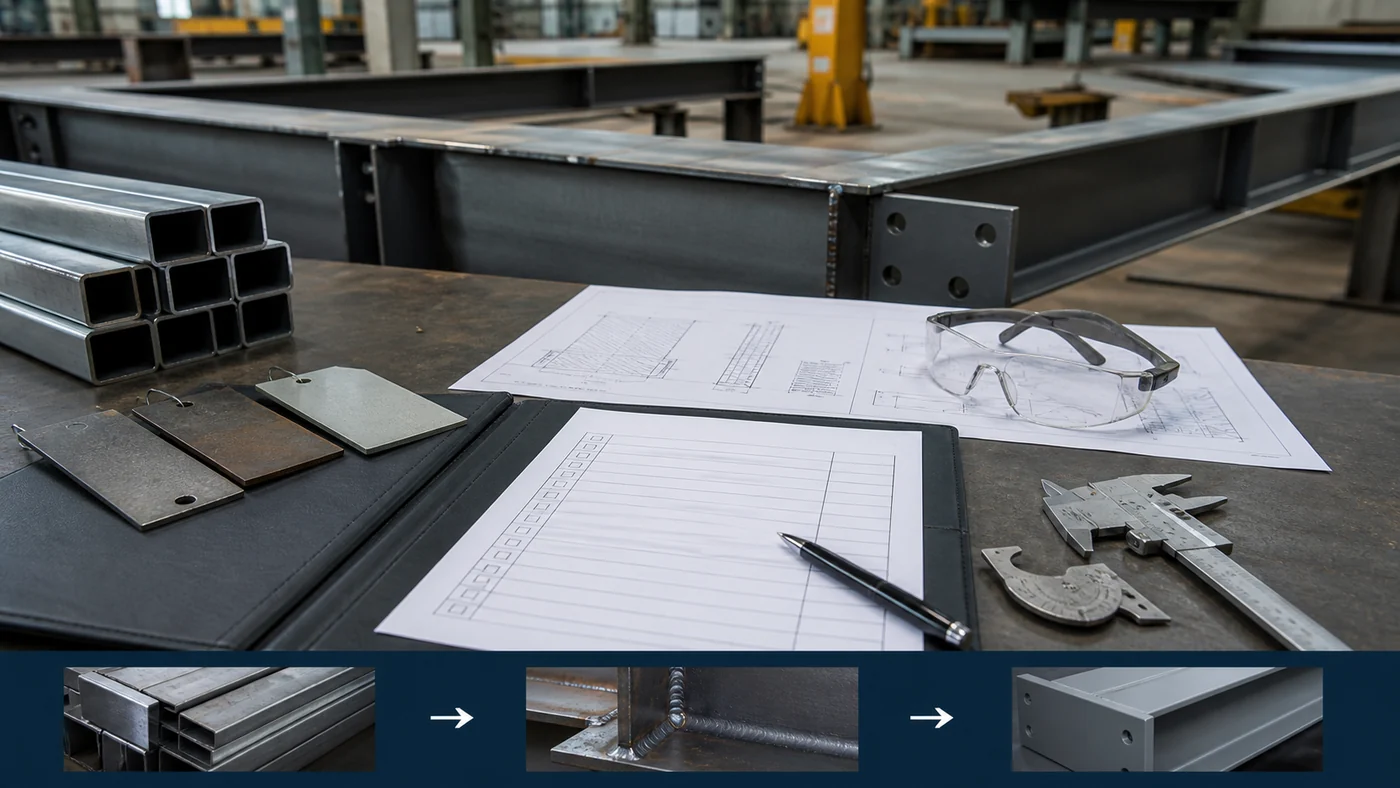
The ITP follows the actual fabrication route, from material receipt and traceability through cutting, fit-up, welding, NDT, dimensional inspection, coating, packing, and release.
Acceptance basis
Every activity points to an approved drawing, project specification, procedure, code, or agreed acceptance document—using its controlled revision.
Participation
Routine review, witness, hold, and record-review points are defined with project-specific meanings, responsible parties, and notice periods.
Evidence and release
Each control point names the record that proves completion and the authority that permits the next stage to start.
An inspection and test plan is a control map, not a substitute for the contract, approved drawings, fabrication procedures, or applicable standards. Its job is to connect those requirements to the real production sequence. When that connection is weak, inspection may still take place, but the buyer may not know whether the correct revision was used, whether an observation was mandatory, or whether an incomplete record should stop release.
This guide is deliberately written from the EPC buyer's side. It does not assign universal hold points or acceptance limits. Those decisions depend on the project contract, risk, jurisdiction, design documents, owner requirements, and the agreed quality plan. The practical objective is to make those project decisions visible before work advances.
1. Start with the six fields that make an ITP executable
Before reviewing individual rows, check whether the ITP structure can answer six questions consistently. A spreadsheet with dozens of activities can still be incomplete if any of these fields is missing.
| Field | Buyer question | Weak wording to challenge |
|---|---|---|
| Activity and stage | What is being checked, and before or after which operation? | “Fabrication inspection” with no sequence or lot definition. |
| Acceptance reference | Which controlled document defines the result as acceptable? | “As per standard” without a document number or revision. |
| Method and extent | How is the check performed, on what population, and at what frequency? | “Random” or “as required” without a selection rule. |
| Responsible parties | Who performs, records, reviews, witnesses, or releases the activity? | One generic “QC” column for every decision. |
| Evidence record | Which report, register, certificate, or signed form proves completion? | “Record available” without a named deliverable. |
| Continuation rule | May work continue, and who authorizes continuation when a point is open? | Blank release logic or approval hidden in remarks. |
2. Map the ITP to the real steel fabrication route
A buyer should be able to trace one material lot or member group from receipt to shipment. The stages below are a review framework, not a universal mandatory list. Add, combine, or remove rows to match the project's scope and risk.
| Stage | Control purpose | Typical evidence to name |
|---|---|---|
| Document readiness | Confirm approved drawings, procedures, material requirements, and inspection documents are available at the correct revision. | Approved-document register, drawing transmittal, procedure approval record. |
| Material receipt and traceability | Link delivered material identity and condition to the specified grade, size, certificate, and future member marks. | Receiving report, MTC review, heat-number or traceability register, segregation record. |
| Cutting and preparation | Control material identity, cutting accuracy, edge condition, hole preparation, and transfer of marks. | Cutting list, dimensional record, traceability transfer record. |
| Fit-up and welding readiness | Confirm joint preparation, fit-up, consumables, approved welding procedures, and personnel qualifications before welding. | Fit-up report, WPS reference, welder identification, consumable-control record. |
| Welding and NDT | Record visual and specified NDT results, link indications to weld identity, and close repairs through re-inspection. | Weld map, visual inspection report, NDT report, repair and re-examination record. |
| Dimensions and trial fit | Verify member geometry, interfaces, holes, camber where specified, and any required assembly checks. | Dimensional report, survey record, trial-assembly record when required. |
| Surface preparation and coating | Confirm environmental conditions, surface preparation, coating application, thickness, curing, and repair status. | Environmental log, surface-preparation record, coating batch record, DFT report, repair closeout. |
| Marking, packing, and release | Match accepted components to packing lists and confirm open quality items do not conflict with release. | Mark list, packing list, release note, open-item register, photo record, turnover index. |
For the supporting document package, use the quality document list before fabrication and the material traceability guide.
3. Define control-point codes in the project, not by assumption
Terms such as hold, witness, surveillance, and review are widely used, but their exact effect can differ between contracts and organizations. The ITP should include a legend that defines each code for this project. A buyer should not assume that a familiar letter automatically creates the same legal or operational obligation on every project.
| Common code | Project definition must answer | Release question |
|---|---|---|
| Hold point | Who must authorize continuation, what evidence is required, and how a waiver or release is documented. | Can the next operation start without a recorded release? |
| Witness point | Who receives notice, how much notice is required, and what happens if the invited party does not attend. | Does documented notice permit work to proceed after the stated period? |
| Surveillance | Whether attendance is discretionary, how observations are recorded, and how adverse findings affect the work. | Does an observed issue trigger a separate stop or NCR process? |
| Document review | Whether the record is reviewed before or after work, the response time, and whether comments suspend release. | Must acceptance be recorded before the lot moves forward? |
If third-party inspection is part of the contract, align the ITP legend, notification rules, and report deliverables with the TPI report review checklist. Attendance alone does not define acceptance; the report status and release authority must also be clear.
4. Make acceptance criteria auditable
“Acceptable” is a conclusion, not an acceptance criterion. Each ITP row should point to the source that supports the conclusion. That source may be an approved drawing, project specification, procedure, code, or agreed inspection instruction. Record the document identifier and revision where revision control matters.
- Do not paste isolated limits into the ITP if doing so separates them from their scope, method, or current revision.
- Do not let the ITP choose an NDT method, extent, or acceptance level that the contract and approved technical documents have not established.
- Do not treat an inspector's signature as proof that every upstream requirement was satisfied; the record should identify what was actually reviewed.
- When drawings change, determine which completed or planned inspections are affected and record the disposition.
The current ISO overview for ISO 17635:2025 explains that selection of weld NDT methods and evaluation depends on quality requirements, material, thickness, welding process, and testing extent. The ISO 3834-1:2021 overview describes criteria for selecting welding quality requirement levels. These are useful context, but the project's specified standards and approved documents determine what applies.
5. Tie every inspection to a record and a status
Evidence should be retrievable by the same identifiers used by procurement, fabrication, and shipment control. If the ITP refers to “Lot 7” but the report uses drawing numbers and the packing list uses member marks, the final dossier needs a reliable cross-reference.
For each record, define at least:
- the component, weld, batch, area, or lot covered;
- the drawing, procedure, and acceptance-reference revision used;
- the inspection date and responsible organization;
- the result and any linked NCR, concession, repair, or re-inspection;
- the review or approval status; and
- the release status for the next operation.
When a result is rejected or conditional, connect it to the NCR closeout evidence. A repaired item should not disappear into a new “accepted” report without a traceable link to the original finding and re-inspection.
6. Review notification and access before approving witness points
A witness requirement fails in practice when the ITP names the point but not the scheduling mechanism. The buyer should check the required notice period, time zone, working calendar, contact route, location, access requirements, and documents that must accompany the notification.
The ITP or an associated procedure should also state what happens when production changes. For example: Is a new notice required if the activity moves by a day? Can the fabricator proceed after documented notice expires? Who records non-attendance? Which changes require the buyer to reconfirm? These are contract-administration questions and should be settled before the first inspection notice is issued.
7. Use a short buyer review sequence before fabrication starts
- Freeze the input list. Record the contract documents, drawings, specifications, procedures, and standards used for the review.
- Walk the production route. Confirm that the ITP covers the actual operations and interfaces, including subcontracted processes.
- Challenge vague rows. Replace “as required,” “random,” “check,” or “review” with a defined basis, extent, record, and decision owner.
- Set participation rules. Agree the code legend, notice process, response times, attendance consequences, and release authority.
- Test traceability. Choose one example member or batch and verify that the proposed records can remain linked from material receipt to packing.
- Close comments formally. Issue an approved revision or a controlled comment register; do not rely on email assumptions around critical points.
- Recheck before release. Confirm that the completed records follow the approved ITP and that deviations are dispositioned before shipment.
Keep the ITP revision aligned with the fabrication drawing revision-control checklist, and use the document turnover checklist before final release.
8. Common ITP failures that create late project risk
| Warning sign | Why it matters | Question to close |
|---|---|---|
| Future production stages are compressed into one row. | Required evidence and release gates may be discovered only after the operation is complete. | Which stage, lot, record, and authorization belong to each operation? |
| Acceptance references have no revision. | Inspector and fabricator may work from different requirements. | How will current revisions be issued and superseded versions prevented from use? |
| NDT extent is described only as “per code.” | The applicable basis, selection rule, or project addition may remain unresolved. | Which approved document defines method, extent, location selection, and acceptance? |
| Witness points have no notice rule. | Production delay or disputed non-attendance becomes likely. | What notice, calendar, response, and proceed rule applies? |
| Records are named but not linked to component identity. | The final dossier may prove that an inspection occurred without proving which steel it covered. | Which common identifier links the report, member, NCR, and packing list? |
| Conditional release is informal. | Open items can move into coating, packing, or shipment without an owner and due date. | Where are conditions, responsibility, deadline, and final closure recorded? |
Buyer questions about steel structure ITPs
Who should prepare the ITP?
The contract or quality plan should define responsibility. In many procurement arrangements the fabricator proposes the ITP and the buyer, owner, engineer, or nominated inspector reviews the parts assigned to them. Review does not transfer the fabricator's responsibility for controlling its work.
Should every inspection be a hold point?
No. Excessive hold points can make the plan unworkable and weaken attention to genuinely critical decisions. Select participation points according to contract requirements, risk, process capability, access, and the consequence of discovering a problem after the next operation.
Can work proceed if a witness party does not attend?
Only according to the agreed project definition and documented notice procedure. The ITP should not leave this decision implicit.
Does an approved ITP replace the project specification?
No. The ITP organizes inspection and evidence against the applicable requirements. The contract, approved design documents, project specifications, procedures, and authorized technical decisions remain controlling.
Sources, scope, and limitations
This article is a general buyer-side review framework, not engineering, welding, NDT, certification, or inspection-body advice. Project contracts, approved drawings, owner requirements, applicable law, authorized engineering decisions, and the current project-specified editions of standards take priority.
- ISO 9001:2015 — Quality management systems — Requirements: ISO lists this edition as current on the publication page at the time of this review; a replacement edition is under publication.
- ISO 3834-1:2021 — Quality requirements for fusion welding of metallic materials: official scope and selection overview.
- ISO 17635:2025 — Non-destructive testing of welds — General rules for metallic materials: official scope for method selection and result evaluation context.
Source pages checked August 21, 2026. This article does not reproduce paid standard text. See the editorial and source review process.