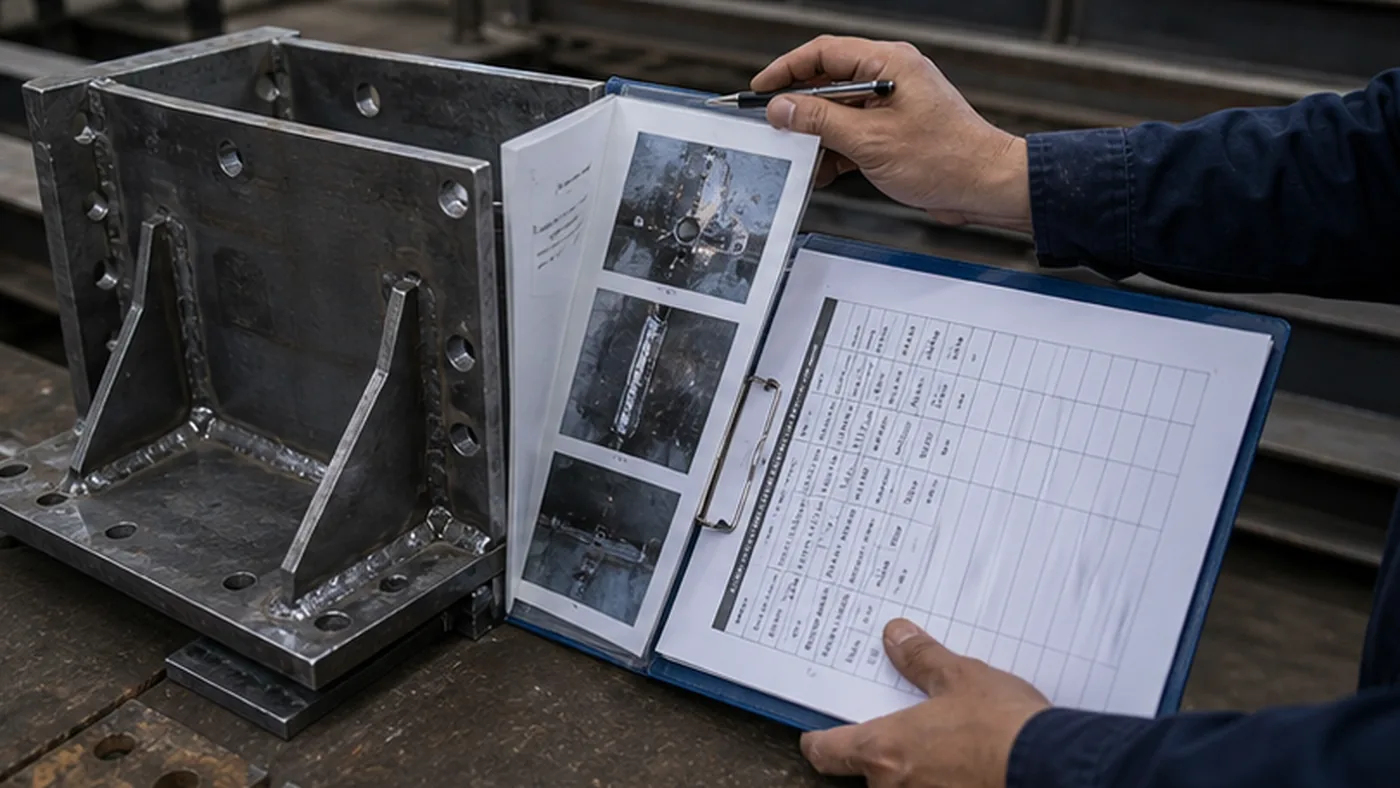
Buyer-focused answer
Quick answer for buyers
Steel structure repair evidence checklist: verify repair method, photos, inspection records, NCR closeout, approval signatures, and release status.
Main question
What should EPC buyers check when using the steel structure repair evidence checklist?
Quick answer
Steel structure repair evidence checklist: verify repair method, photos, inspection records, NCR closeout, approval signatures, and release status.
When to use this page
Use it before fabrication release, before shipment, or before final handover when missing records can delay acceptance.
What to verify
Start with the original defect record; Confirm repair method approval; Capture before, during, and after photos; Attach inspection and test records
Related next step
A steel structure repair evidence checklist helps EPC buyers verify that a repaired item is ready for NCR closeout, shipment release, or site installation. A repair should not be closed only because a supplier says it is finished. The buyer needs evidence showing the original defect, approved repair method, repair execution, final inspection, and release status.
This checklist is useful after fabrication repair, coating repair, dimensional correction, welding repair, site damage repair, packing damage repair, or any NCR disposition that requires correction before acceptance.
1. Start with the original defect record
Repair evidence should begin with the defect that triggered the repair. The file should identify the NCR, inspection comment, quality hold, site issue, or delivery damage report. It should also identify the affected component mark, package, drawing revision, location, and requirement that was not met.
If the original defect record is unclear, the repair evidence will also be weak. The buyer should not approve closeout until the repaired item can be linked back to the exact defect and affected scope.
2. Confirm repair method approval
The repair method should be approved before the supplier or site team performs the repair, especially when the work affects welding, structural geometry, connection fit, coating system, galvanizing repair, or material traceability. The approval may come from the buyer, project quality engineer, structural engineer, owner representative, or approved procedure depending on the project rules.
| Repair type | Approval evidence to request |
|---|---|
| Weld repair | Approved repair method, WPS reference, welder qualification if required, NDT requirement. |
| Coating repair | Surface preparation method, compatible paint, DFT requirement, curing condition. |
| Dimensional correction | Engineering comment, tolerance reference, re-measurement plan. |
| Marking or packing correction | Corrected mark list, label photo, packing list update. |
| Site damage repair | Site repair request, method approval, before and after photos. |
3. Capture before, during, and after photos
Photo evidence should show more than the final condition. A complete record usually includes the original defect, preparation stage, repair activity, and final accepted condition. Photos should include the component mark, location, scale reference when useful, and date or file naming that connects to the repair record.
For coating and surface repairs, photos should show cleaning, surface preparation, primer or repair material application, final surface, and any DFT measurement evidence. For dimensional repair, photos should be supported by measurement records rather than appearance only.
4. Attach inspection and test records
Repair evidence should include the inspection records required by the repair method. This may include dimensional re-check, weld visual inspection, NDT report, coating DFT report, adhesion test where required, galvanizing thickness check, bolt package verification, or packing re-check.
The record should state whether the result passed, failed, or remains conditional. If the repair fails re-inspection, the buyer should keep the item open and require a new disposition decision.
5. Link evidence to NCR closeout
If the repair is related to an NCR, the repair evidence should support the NCR closeout. The NCR package should show the original nonconformance, approved disposition, repair method, evidence of completed work, re-inspection result, final release decision, and signatures.
Do not close an NCR with only a final photo if the required method, inspection, or approval record is missing. A complete closeout package reduces disputes when the same item is reviewed during shipment, site receiving, or owner handover.
6. Confirm the repaired item is released
Repair completion and release are different. A repaired item may still need re-inspection, document update, owner approval, or site instruction before it can be used or shipped. The repair evidence checklist should include the final release status: released, released with condition, transferred to site, held, rejected, or pending evidence.
| Release status | Evidence required |
|---|---|
| Released | Final inspection result and required signatures. |
| Released with condition | Condition owner, due date, closeout evidence, and acceptance authority. |
| Transferred to site | Site team instruction and remaining action record. |
| Held | Hold reason, responsible party, next action, and target date. |
| Rejected | Replacement or disposal decision and material control update. |
7. Update documents after repair
Some repairs require document updates. The buyer should check whether the inspection report, NCR register, packing list, mark list, coating report, material control log, handover file, or site issue log has been updated. If the repair changes a dimension, connection, coating area, or component status, the final document package should make that clear.
Repair evidence that remains only in email or chat is hard to retrieve later. Store the evidence in the quality package with clear file names and references.
8. Check repeated repair patterns
Repair evidence should also support supplier performance review. If the same defect type keeps needing repair, record the pattern. Repeated coating scratches, recurring dimensional corrections, repeated packing damage, or repeated label corrections may show weak process control.
When the pattern repeats, the buyer should request corrective action, not only accept item-by-item repair evidence.
9. Use a repair evidence scorecard
A scorecard helps decide whether the repair package is strong enough for release.
| Evidence area | Suggested weight | Review point |
|---|---|---|
| Defect identity | 15% | NCR, component mark, location, drawing, and scope are clear. |
| Method approval | 20% | Repair method was approved by the correct authority. |
| Photo evidence | 20% | Before, during, and after photos show the repair trail. |
| Inspection record | 25% | Required tests and re-inspection records are complete. |
| Release status | 10% | Final status is signed and unambiguous. |
| Document update | 10% | NCR, register, and quality package are updated. |
Warning signs
- Repair is claimed complete but the approved method is missing.
- Photos show only the final condition, not the original defect or repair process.
- Re-inspection records are missing after structural, dimensional, weld, or coating repair.
- The repaired component mark is not visible in the evidence file.
- NCR is closed while release status is still pending.
- The same defect type requires repair repeatedly without corrective action.
Scope boundary: build the repair evidence dossier
This checklist controls the records that prove what happened to a repaired component. It is not the inspector's physical acceptance checklist and it does not authorize release. Assemble a traceable dossier linking the original defect, approved repair method, component mark, work records, inspection results, photographs, signatures, and final document revision.
- Pass when every evidence file traces to one component, one repair instruction, and one inspection result.
- Hold when a file has no clear component mark, date, revision, or approving party.
- Continue to post-repair inspection and release only after the dossier is internally consistent.
Buyer note
Good repair evidence should tell the full story: what was defective, how the repair was approved, what work was done, how the result was inspected, who accepted it, and whether the item is released. This makes repair closeout defensible for shipment, site installation, and owner handover.
Audit trail, distribution, and transmittal evidence for repaired components
The controls below preserve the detailed checks from the retired micro-checklists. Apply only the sections relevant to the component, contract, approved repair method, and project authority matrix.
Steel structure repaired component audit trail checklist
A steel structure repaired component audit trail checklist helps EPC teams prove that a repaired member was controlled from first issue to final archive. The audit trail is more than a folder of repair photos. It should connect the defect, approved repair method, inspection evidence, release decision, owner acceptance, final record, and archive path in a sequence that can be reviewed later without guessing.
This checklist is written for EPC quality teams, document controllers, third-party inspection coordinators, site managers, and project closeout teams. It is useful when a repaired steel column, beam, brace, truss part, connection plate, or secondary member has passed repair but still needs a defensible evidence chain for owner audit or project handover.
1. Start the trail with the original issue
The audit trail should begin with the first controlled record that identified the problem. This may be a factory NCR, receiving damage report, site discrepancy report, erection issue, owner comment, or inspection hold. The first record should explain what happened, where the component was located, and why the issue required controlled repair.
- Component mark, batch, drawing revision, package, and installed or stored location.
- Original issue type: damage, fabrication defect, coating defect, wrong mark, missing part, dimensional problem, or owner comment.
- Discovery date, person or organization reporting the issue, and supporting photos.
- Initial risk decision: hold, repair, concession, replace, monitor, or use as is.
- Log reference: NCR, quality hold, punch item, site issue log, or discrepancy number.
If the issue came from a formal NCR, compare the record with the steel structure NCR closeout evidence checklist.
2. Link the approval decision
A strong audit trail shows that repair work was approved before it was performed or clearly controlled if emergency work started first. The approval should match project procedures, contract requirements, and the severity of the defect.
| Approval record | Audit trail question |
|---|---|
| Repair method statement | Was the repair method clear, approved, and linked to the affected component? |
| Engineering review | Was engineering approval required for strength, fit-up, connection, or concession risk? |
| Owner or EPC approval | Was the buyer or owner approval recorded when the contract required it? |
| Quality hold release condition | Were inspection and evidence requirements defined before release? |
| Concession decision | Was any accepted condition or limitation documented and traceable? |
For site repair approval control, use the steel structure field repair approval checklist.
3. Prove repair execution
The audit trail should show what was actually done, not only what was planned. Repair execution evidence should match the approved method and identify the same component mark throughout the record.
- Before, during, and after repair photos with component mark visible where practical.
- Welding, grinding, straightening, drilling, coating touch-up, or replacement action records.
- Welder qualification, WPS, NDT, dimensional check, coating DFT, or material evidence when required.
- Supervisor and inspector names, dates, and inspection points.
- Explanation for any difference between approved method and actual repair work.
For the photo set, review the steel structure repair photo record checklist.
4. Connect inspection and re-inspection records
Repair evidence is incomplete until the repaired area has been inspected. The audit trail should connect repair execution with inspection status, rework, and final release decision. If the component moved from factory to site or from storage to erection, include the relevant inspection steps.
| Inspection point | Evidence to link |
|---|---|
| Post repair inspection | Repair area condition, measurements, NDT, coating repair, and inspector decision. |
| Receiving or storage check | Condition after transport, mark identity, protection, and hold status. |
| Erection release | Decision that the repaired component can be installed or kept on hold. |
| Post erection inspection | Installed condition, alignment, touch-up, final photos, and remaining issue status. |
| Final review | Punch closeout, owner acceptance, limitation status, and final archive decision. |
For the inspection step after repair, use the steel structure post repair inspection checklist.
5. Keep status changes consistent
Audit problems often come from conflicting status records. A repaired component may appear closed in the NCR log, open in the punch list, released in a site tracker, and missing in the turnover file. The audit trail should reconcile these status changes.
- Original status: open, hold, rejected, damaged, missing evidence, or pending approval.
- Repair status: approved, in progress, repaired, rework required, or inspection pending.
- Release status: released for shipment, released for erection, released with limitation, or still on hold.
- Acceptance status: owner accepted, accepted with comment, rejected, or transferred.
- Archive status: indexed, archived, retrieval tested, or reopened.
For final release controls, compare with the steel structure post repair release checklist.
6. Show who approved each step
The audit trail should identify decision authority. Names and dates matter because repaired component records may be reviewed months after installation, when project staff have changed.
| Decision | Responsible role to record |
|---|---|
| Defect classification | Inspector, quality manager, or discipline engineer. |
| Repair method approval | Supplier, EPC quality reviewer, engineer, or owner representative. |
| Inspection acceptance | Qualified inspector, third-party inspector, or site quality lead. |
| Release decision | Quality manager, site manager, or package owner. |
| Final acceptance and archive | Owner representative, EPC closeout owner, and document controller. |
If owner approval is part of the trail, use the repaired component owner acceptance checklist.
7. Verify the final archive link
The audit trail is not complete if the final record cannot be found. The archive link should point to a controlled file location, document management record, or transmittal reference. It should also connect back to the final acceptance decision.
- Final acceptance record number and decision wording.
- Evidence index number, revision, owner, and archive path.
- Archive folder or document management link that opens for authorized reviewers.
- Obsolete drafts separated from final records.
- Search fields tested by component mark, NCR number, drawing number, package, and location.
For file naming and archive control, use the repaired component archive checklist.
8. Audit trail checklist table
Use this summary table before marking a repaired component audit trail complete.
| Trail element | Pass condition |
|---|---|
| Issue origin | The original defect or discrepancy record is identifiable and linked. |
| Approval | The repair method, engineering review, concession, or owner approval is traceable. |
| Execution | Repair photos and work records match the approved method and same component mark. |
| Inspection | Post repair and relevant site inspection records confirm acceptance or rework. |
| Status | NCR, hold, punch, release, acceptance, and archive statuses do not conflict. |
| Archive | The final record and evidence index are stored in a retrievable controlled location. |
Red flags in repaired component audit trails
- The repair record exists but does not identify the original defect or NCR.
- Repair photos show work was done, but no approved repair method is linked.
- The inspection record accepts the repair, while the quality hold is still open.
- Owner acceptance is recorded in email but missing from the final trail.
- The archive folder contains files, but no evidence index explains the sequence.
- Component marks change between defect report, repair record, inspection report, and final archive.
Buyer note
A repaired component audit trail should let an EPC buyer answer five questions quickly: what was wrong, who approved the repair, what work was done, who accepted it, and where the final evidence is archived. When the trail is complete, the repaired steel structure component can be defended during owner review, warranty discussion, project closeout, and later maintenance audit.
Steel structure repaired component distribution list checklist
A steel structure repaired component distribution list checklist helps EPC teams control who receives the latest repair status and supporting records. Repair closeout can fail even when the technical repair is acceptable, because the site team, owner reviewer, document controller, or supplier is working from an old document set. A controlled distribution list prevents repaired components from moving forward with missing evidence or outdated release conditions.
This checklist is written for EPC quality managers, document controllers, site coordinators, supplier managers, third-party inspection teams, and owner representatives. It applies after a repaired steel component has generated records such as an NCR, repair method, inspection report, release note, owner comment response, final acceptance record, or archive package.
1. Define the distribution purpose
The distribution list should not be a generic email group. It should explain why repaired component records are being sent and what decision the recipients need to make. Different stages require different recipients and different document packages.
- Repair approval distribution for method review before work starts.
- Inspection distribution for re-inspection, NDT, coating repair, or dimensional check evidence.
- Release distribution for shipment, storage, erection, or site use decision.
- Owner acceptance distribution for comment closure and final review.
- Archive distribution for document control, turnover, warranty, and future audit access.
For the upstream record control process, use the repaired component document control checklist.
2. Identify required recipient groups
The correct recipients depend on the repair severity, project stage, contract approval requirements, and whether the component is still at the factory, in transit, stored at site, installed, or already handed over. The distribution list should be specific enough to avoid missed decisions.
| Recipient group | Why they need the record |
|---|---|
| Supplier or fabricator | Receives approval comments, evidence requests, rework requirements, and final closeout status. |
| EPC quality team | Controls inspection decision, NCR closure, hold release, and repair evidence completeness. |
| Site construction team | Needs release status, installation conditions, limitations, and repaired mark identification. |
| Document control | Maintains the latest revision, transmittal, evidence index, obsolete files, and archive link. |
| Owner or owner representative | Reviews acceptance records, limitations, comment responses, and final evidence package. |
3. Match distribution to repair stage
Not every recipient needs every file at every stage. The distribution list should match the repair stage so recipients receive useful records rather than a large uncontrolled package.
| Repair stage | Typical distribution package |
|---|---|
| Issue opened | Defect report, component mark, location, photos, initial hold status, and required response date. |
| Repair method review | Repair proposal, drawing reference, inspection plan, approval route, and comment sheet. |
| Repair completed | Execution record, repair photos, inspection request, and updated issue status. |
| Release decision | Inspection result, hold release, limitations, installation conditions, and distribution confirmation. |
| Final closeout | Owner acceptance, final acceptance record, evidence index, archive path, and transferred items. |
For final status proof, compare with the repaired component audit trail checklist.
4. Include the right distribution fields
A repaired component distribution list should make the transmittal defensible. It should show what was issued, who received it, what revision was current, and whether the recipient must take action.
- Distribution date, sender, recipient organization, recipient role, and contact route.
- Component mark, package, drawing number, NCR or issue reference, and repair record number.
- Document title, revision, status, and whether superseded files are withdrawn.
- Required action: review, approve, inspect, release, install, archive, or acknowledge.
- Response due date, comment return path, and final distribution confirmation.
For final archive fields, use the repaired component archive checklist.
5. Control release notes and limitations
Distribution risk is highest when a repaired component is accepted with conditions. The site team and owner should not need to search the full repair package to know whether there is a limitation, concession, monitoring item, or installation condition.
- State whether the component is released without limitation, released with limitation, or still blocked.
- Include concession number, owner comment, engineering note, or monitoring requirement where applicable.
- Send release notes to site teams before the repaired component is installed or handed over.
- Confirm that limitations appear in the final acceptance and archive records.
- Withdraw earlier release notes if a later inspection or owner comment changes the decision.
For release control, use the steel structure post repair release checklist.
6. Track acknowledgements and responses
A distribution list should not only show that records were sent. It should also show whether critical recipients acknowledged the latest status or returned comments. This matters when release, owner acceptance, or final closeout depends on a response.
| Recipient action | Control requirement |
|---|---|
| Acknowledgement | Record that the recipient received the latest revision and understands the action required. |
| Review comment | Log comment, owner, response due date, reply status, and whether the document must be revised. |
| Approval | Capture approval wording, approver authority, date, and any conditions or limitations. |
| Rejection | Record reason, required correction, re-distribution trigger, and revised evidence requirement. |
| No response | Escalate when the recipient response is required before release, acceptance, or archive. |
For owner response control, use the repaired component owner acceptance checklist.
7. Prevent obsolete distribution
When a repaired component record is revised, earlier recipients may still keep old files. The distribution list should control withdrawal or superseding of the previous revision so site teams and owners do not act on outdated information.
- Mark previous repair method, release note, or acceptance record as superseded.
- Notify recipients when a revision changes the repair method, limitation, release status, or inspection result.
- Keep a superseded distribution record for audit, but make the latest record easy to identify.
- Update the document control register, NCR log, quality hold log, and archive index together.
- Confirm old attachments are removed from shared working folders where possible.
8. Final distribution list checklist
Use this short checklist before closing the distribution record for a repaired component:
- The distribution purpose is clear: approval, inspection, release, owner acceptance, or archive.
- Recipients match the repair stage, project procedure, contract requirement, and decision authority.
- Document titles, revisions, statuses, component marks, and issue references are listed correctly.
- Release notes and accepted limitations are distributed to teams that need them before use or handover.
- Required acknowledgements, approvals, comments, and rejections are tracked to closure.
- Superseded files are withdrawn, marked obsolete, or replaced with the latest controlled revision.
Red flags in repaired component distribution
- The repaired component is released, but the site team was not copied on the release note.
- The owner received photos but not the final acceptance record or limitation statement.
- A revised repair method was issued, but previous recipients were not told to ignore the old version.
- The distribution list uses a generic email group with no roles or required actions.
- Inspection comments are returned but not logged, answered, or linked to the final record.
- The archive path is available to document control but not to the closeout or owner review team.
Buyer note
A repaired component distribution list is a control tool, not an email formality. EPC buyers should require the list to show who received the latest repair records, what action was required, which revisions were current, what limitations were accepted, and how final archive access was shared. This prevents old repair status from reaching site work or owner closeout.
Steel structure repaired component document control checklist
A steel structure repaired component document control checklist helps EPC teams prevent repair records from becoming scattered across emails, inspection folders, supplier uploads, and site trackers. A repaired component can pass inspection, but if the approved method, repair photos, release note, owner acceptance, and final archive record are not controlled as one document chain, the closeout package remains weak.
This checklist is written for EPC document controllers, quality managers, supplier coordinators, site teams, and owner review teams. It focuses on controlled records for repaired steel columns, beams, braces, trusses, plates, connection parts, and secondary steel members after a defect, damage event, NCR, concession, or field repair.
1. Register the repaired component record set
Document control should start when the repair is first opened, not only at final closeout. The repaired component record set should be registered with a stable reference so quality, site, supplier, and owner teams can find the same package.
- Project name, area, package, drawing number, component mark, and installed or storage location.
- NCR number, concession reference, quality hold, site issue log, or punch item number.
- Record set owner, document controller, quality reviewer, and supplier contact where applicable.
- Required records: defect report, approved repair method, repair evidence, inspection result, release, acceptance, and archive.
- Current record status: open, under review, approved for repair, repaired, released, accepted, archived, or reopened.
For the full evidence sequence, use the repaired component audit trail checklist.
2. Control document numbers and revisions
Repair files are often revised quickly after engineer comments, owner review, or site inspection. Each controlled record should show revision, date, author, reviewer, and approval status. This prevents an old repair method or draft acceptance note from being used after a later decision.
| Document type | Revision control requirement |
|---|---|
| Defect or NCR record | Keep original issue reference, severity, latest status, and closure revision visible. |
| Repair method | Control approved revision, engineer comments, supplier response, and superseded method notes. |
| Inspection record | Identify inspection date, repaired mark, accepted area, rework note, and final accepted revision. |
| Owner acceptance | Record comment responses, accepted limitations, decision date, and final issued revision. |
| Archive index | Freeze the final evidence index and document path after closeout approval. |
For repair method and approval evidence, compare with the steel structure field repair approval checklist.
3. Define approval routing
Every repaired component record does not need the same approval route, but the required route should be clear. A cosmetic coating touch-up may need supplier quality and EPC review. A structural repair or concession may need engineer and owner approval before work continues.
- Supplier or fabricator prepares the repair proposal and supporting evidence.
- EPC quality reviews completeness, component identity, and inspection requirements.
- Engineer reviews structural impact, concession, limitation, or alternative acceptance where required.
- Owner or owner representative reviews records when contract, ITP, or NCR procedure requires approval.
- Document controller records each approval, rejection, comment response, and final issued status.
For owner review, use the repaired component owner acceptance checklist.
4. Manage distribution and access
Repair records must reach the teams that make decisions. If the repair method is approved but the site team receives an obsolete file, installation or closeout risk increases. Distribution records should show who received the controlled document and when.
| Recipient group | Document control purpose |
|---|---|
| Supplier or fabricator | Receives approved repair instructions, comment responses, and required evidence list. |
| Factory or site quality | Receives inspection hold points, acceptance criteria, and re-inspection requirements. |
| Site construction team | Receives release status, limitations, installation conditions, and hold removal notice. |
| Owner or EPC closeout team | Receives acceptance records, evidence index, and archive path for final review. |
| Document control | Maintains the master register, superseded versions, and final archive status. |
For final release after repair, review the steel structure post repair release checklist.
5. Mark obsolete files clearly
Old versions should not disappear without control, but they must be marked so they are not used by mistake. Obsolete repair methods, draft inspection records, and earlier owner comments should be separated from final documents.
- Move superseded files to an obsolete folder or mark them as superseded in the register.
- Keep the reason for superseding the file, such as revised repair method, additional inspection, or owner comment.
- Prevent obsolete repair methods from being printed or distributed for current work.
- Keep previous revisions available for audit when they explain how the decision changed.
- Make final documents easy to identify by title, revision, issue date, and status.
6. Reconcile document status with quality status
Document status and quality status should not contradict each other. A repaired component should not be marked released if the approved inspection record is still missing. Likewise, a final archive package should not remain open if all acceptance documents are approved and filed.
| Quality status | Document control check |
|---|---|
| Repair approved | Approved repair method, approver, revision, and distribution record are present. |
| Repair completed | Execution photos, repair record, and required inspection requests are filed. |
| Repair accepted | Post repair inspection, rework closure, and accepted condition are controlled. |
| Released for use | Hold release, limitations, installation conditions, and site distribution are recorded. |
| Archived | Final acceptance, evidence index, archive path, and retrieval test are complete. |
For archive completeness, use the repaired component archive checklist.
7. Control email approvals and informal evidence
Many repair decisions happen through email or messaging before they are added to the formal record. Important approvals should be converted into controlled records or registered with enough detail to support later review.
- Save approval emails as PDF or attach them to the document control register.
- Record sender, recipient, date, subject, component mark, and decision wording.
- Separate comments from approvals so an informal discussion is not treated as final acceptance.
- Transfer critical email decisions into the repair method, inspection record, or acceptance record.
- Keep the final controlled document as the reference used for closeout.
8. Final document control checklist
Use this short checklist before closing the repaired component document control package:
- The repaired component record set is registered with component mark, issue reference, owner, and status.
- All major documents have controlled numbers, revisions, dates, authors, reviewers, and approval status.
- The approval route matches defect severity, contract requirement, engineering risk, and owner review needs.
- Distribution records show that supplier, quality, site, owner, and closeout teams received the right files.
- Obsolete drafts and superseded repair methods are clearly separated from final documents.
- Document status matches NCR, quality hold, release, acceptance, and archive status.
Red flags in repaired component document control
- The latest repair method is stored in email but not in the controlled document system.
- Inspection records use a different component mark than the NCR or repair approval.
- Site teams received a release note before owner comments were closed.
- Old and final files are mixed in one folder without revision status.
- The archive index is final, but the quality hold log still shows the item as open.
- A repaired component has acceptance evidence, but no distribution record for the site or owner team.
Buyer note
Good document control makes repaired component evidence usable. EPC buyers should require a repaired component record set that has controlled revisions, clear approvals, correct distribution, obsolete file control, and status consistency with quality logs. This keeps the repair decision defensible and prevents late project closeout from depending on scattered emails or personal folders.
Steel structure repaired component transmittal record checklist
A steel structure repaired component transmittal record checklist helps EPC document control teams prove that repair records were formally issued, not only emailed informally. For a repaired component, the transmittal record should connect document revision, issue date, recipients, required action, response status, and final closeout result. This matters when quality, site, owner, and supplier teams need to prove they acted on the same document set.
This checklist is written for EPC document controllers, quality managers, supplier coordinators, site construction teams, third-party inspectors, and owner representatives. It applies to repaired steel columns, beams, braces, connection plates, truss members, roof framing, wall supports, and secondary steel components where a repair package must be issued and tracked.
1. Define the transmittal purpose
The transmittal should state why the repaired component documents are being issued. A vague file transfer makes it difficult to prove whether the recipient was expected to review, approve, inspect, acknowledge, archive, or take no action.
- Issue for review: recipient must check the repair method or evidence and return comments.
- Issue for approval: recipient must approve, reject, or approve with conditions.
- Issue for information: recipient must know the latest status but no formal reply is needed.
- Issue for construction or site use: site team needs the latest release and limitation status.
- Issue for closeout or archive: document control and owner teams need final evidence access.
For deciding who belongs on the recipient list, use the repaired component distribution list checklist.
2. Identify the repaired component clearly
The transmittal record should identify the repaired component without requiring recipients to open every attachment. This is important when one project has many repaired marks, repeated NCRs, or similar components in different areas.
| Identification field | Why it matters |
|---|---|
| Component mark | Connects the transmittal to the exact repaired member or assembly. |
| Drawing number and revision | Confirms the design or shop drawing basis used for the repair decision. |
| NCR or issue reference | Links the record to the defect, concession, hold, punch item, or site issue. |
| Location or package | Shows whether the component is at factory, in shipment, stored at site, installed, or turned over. |
| Repair package number | Groups related repair approvals, inspection records, release notes, and acceptance records. |
For the complete evidence chain, compare with the repaired component audit trail checklist.
3. List transmitted documents and revisions
A useful transmittal record should list each document separately with title, revision, status, and issue date. This prevents later disputes about whether a recipient received the latest repair method or an obsolete file.
- Defect report, NCR, site issue report, or discrepancy record.
- Repair method, engineering approval, concession, or accepted condition record.
- Repair photo record, inspection report, NDT record, coating repair record, or dimensional check.
- Release note, quality hold release, owner comment reply, or final acceptance record.
- Evidence index, archive path, and final closeout package reference.
For revision and obsolete file control, use the repaired component document control checklist.
4. Record recipients and required actions
The transmittal should make each recipient's required action visible. If the same package is sent to several parties, some may need to approve while others only need to acknowledge or update their logs.
| Recipient | Typical required action |
|---|---|
| Supplier or fabricator | Respond to comments, revise records, complete repair evidence, or confirm closure. |
| EPC quality team | Review completeness, update NCR status, approve release, or request re-inspection. |
| Site team | Use latest release conditions, hold status, limitation notes, or installation instructions. |
| Owner representative | Approve, comment, reject, acknowledge final closeout, or accept with limitation. |
| Document controller | Update register, archive final version, withdraw obsolete files, and track response status. |
5. Track response dates and status
A transmittal is incomplete if response requirements are unclear. The record should show when each response is due, what answer was received, and whether a revised issue is required.
- Required response date and escalation date for overdue approval or comments.
- Response received date, responder name, and response type.
- Status: accepted, accepted with comments, rejected, revised and reissued, acknowledged, or no response required.
- Comment log number or reply reference when comments are returned.
- Reissue trigger when the response changes the repair method, release note, or final acceptance record.
For owner acceptance responses, use the repaired component owner acceptance checklist.
6. Connect transmittal status to quality logs
The transmittal register should align with quality records. If a repair package was issued for approval but no approval was returned, the NCR or hold log should not show final closure. If a final acceptance record was transmitted for archive, the archive status should be updated.
| Quality log | Transmittal alignment check |
|---|---|
| NCR log | Shows the same repair approval, inspection, and closure status as the transmitted package. |
| Quality hold log | References the transmittal that supports hold release or continued hold. |
| Punch list | Shows whether repair-related comments were closed, transferred, or accepted with limitation. |
| Turnover index | Includes the final transmittal or archive path for the repaired component package. |
| Archive register | Confirms the final issued documents are stored and retrievable. |
For final archive checks, use the repaired component archive checklist.
7. Control revised and superseded transmittals
If a repaired component document is revised, the new transmittal should identify what changed and whether earlier recipients must stop using the previous issue. This prevents an old repair method, old release condition, or incomplete acceptance package from remaining in circulation.
- Reference the previous transmittal number and revision.
- State which files are superseded, withdrawn, or replaced.
- Highlight changed release status, limitations, inspection results, or owner comments.
- Redistribute to every recipient affected by the revision.
- Keep previous transmittals available for audit, but clearly mark the latest controlled issue.
8. Final transmittal record checklist
Use this short checklist before marking a repaired component transmittal complete:
- The transmittal purpose is clear: review, approval, information, site use, closeout, or archive.
- The repaired component is identified by mark, drawing, issue reference, package, and location.
- Every transmitted document is listed with title, revision, status, and issue date.
- Recipients and required actions are recorded by role, not only by email address.
- Response due dates, received dates, comment references, and final response status are tracked.
- Revised or superseded transmittals are controlled and linked to the latest final package.
Red flags in repaired component transmittals
- The package was sent by email but no transmittal number or issue date exists.
- Recipients received attachments but no required action or response deadline.
- A site team used an old release note because the revised transmittal did not identify superseded files.
- The NCR log says closed, but the owner approval transmittal still shows no response.
- The archive path is listed in the final record but not issued to document control or owner review.
- Different recipients received different revisions without a controlled reissue record.
Buyer note
A repaired component transmittal record gives EPC buyers proof that important repair documents were issued under control. It should show what was sent, which revision was current, who received it, what action was required, what response was returned, and how the final package was closed or archived. This keeps repaired steel structure evidence usable during project closeout and later owner audit.
Buyer follow-up questions
How should buyers use this page?
Use it as a practical review aid for steel structure repair evidence checklist. The page helps the buyer confirm what must be checked, what evidence should be requested, and which follow-up actions should be closed before the package moves to the next procurement step.
When should this review happen?
Use it before shipment release, final document turnover, or owner handover when traceability and acceptance records need to be closed.
What evidence should be kept?
Keep the records that prove the decision, especially certificates, heat numbers, inspection records, NCR closure, coating reports, signatures, revisions, and final handover files. Photos, comments, approvals, open issues, and closeout notes should stay linked to the relevant drawing, supplier reply, shipment, or handover record.
How to use this checklist
Check this buyer-side checklist against the contract, approved drawings, owner requirements, engineer instructions, and the current edition of every project-specified standard. See the editorial and source review process.