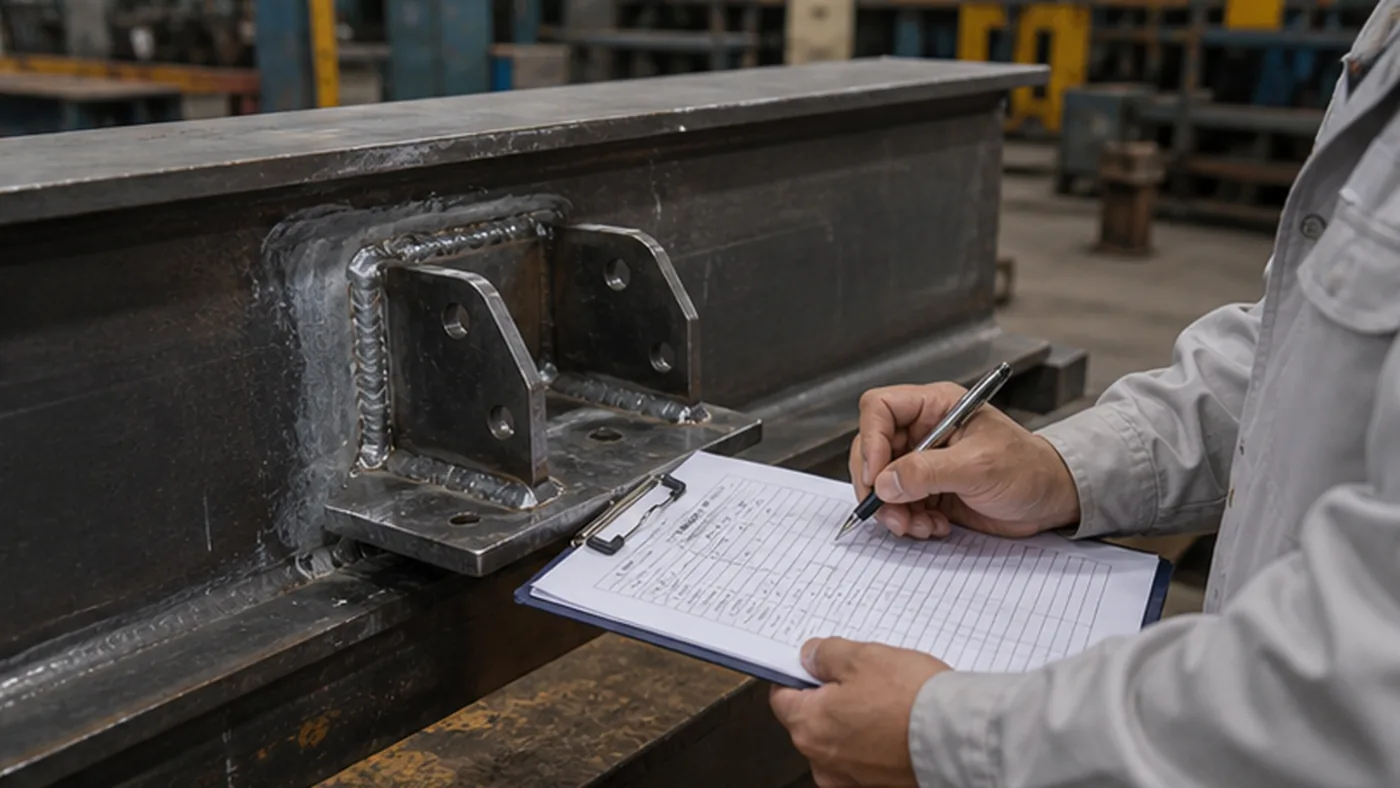
Buyer-focused answer
Quick answer for buyers
Steel structure repair closeout checklist: confirm approval, repair photos, re-inspection, NCR closure, quality hold release, and installation status.
Main question
What should EPC buyers check when using the steel structure repair closeout checklist?
Quick answer
Steel structure repair closeout checklist: confirm approval, repair photos, re-inspection, NCR closure, quality hold release, and installation status.
When to use this page
Use it before fabrication release, before shipment, or before final handover when missing records can delay acceptance.
What to verify
Confirm the original issue is clearly identified; Verify repair approval before accepting completion; Check repair photo evidence; Complete re-inspection records
Related next step
A steel structure repair closeout checklist helps EPC teams confirm that a repaired component is properly approved, inspected, documented, and released. Repair closeout is more than saying the work is finished. It should prove that the defect was controlled, the repair method was accepted, the final condition was inspected, and any hold or NCR was closed before the item is used.
This checklist is written for EPC buyers, site quality engineers, inspectors, material controllers, and erection supervisors who need a clear evidence trail from repair approval to installation release.
1. Confirm the original issue is clearly identified
Repair closeout starts with the original issue record. If the issue is not clearly identified, the closeout may not be traceable during handover or later dispute review.
| Original issue item | Closeout check |
|---|---|
| Issue or NCR number | The closeout record uses the same reference as the issue log, NCR, or quality hold. |
| Component identity | Component mark, package number, drawing, and erection area are recorded. |
| Defect description | The issue type and location match the repair approval and photo evidence. |
| Status before repair | The record shows whether the item was held, rejected, approved for repair, or pending decision. |
For the approval step before closeout, use the field repair approval checklist.
2. Verify repair approval before accepting completion
Closeout should not accept a repair that was never approved. The team should confirm the repair method and approval authority before changing the item status.
- Approved repair method or written instruction is attached.
- Engineering approval is included if the repair affects strength, connection, fit-up, holes, welding, straightening, or cutting.
- Supplier or project approval is attached where required by the contract.
- Repair scope in the approval matches the actual repaired defect.
- Any limitation or use-as-is decision is clearly stated.
If the item was blocked from use, confirm the related site quality hold checklist is updated.
3. Check repair photo evidence
Repair closeout should include enough photo evidence to show the full repair history, not only the final surface.
| Photo stage | Evidence required |
|---|---|
| Before repair | Defect, component mark, package or location, and overall component context. |
| During repair | Preparation, hidden work, hold points, repair material, welding, drilling, or coating steps. |
| After repair | Final condition, close-up view, overall view, and repaired area location. |
| Final release | Inspector confirmation, status tag, measurement, DFT, NDT, or fit-up evidence where required. |
For detailed photo requirements, use the repair photo record checklist.
4. Complete re-inspection records
A repaired item should be re-inspected before closeout. The inspection record should match the repair type and project acceptance criteria.
- Visual inspection result after repair.
- Dimensional check or fit-up confirmation if geometry was affected.
- NDT result if welding repair or crack repair requires testing.
- DFT or coating repair inspection if surface protection was repaired.
- Bolt, hole, accessory, or connection verification if small parts were involved.
For coating-specific closeout, review the coating inspection checklist.
5. Close NCR, issue log, or quality hold status
Repair closeout should update all related control records. If one record says "closed" while another still says "hold," site teams may install the wrong item or delay usable material.
| Control record | Closeout action |
|---|---|
| NCR | Attach repair approval, evidence, inspection result, acceptance, and closeout signature. |
| Site issue log | Update action owner, due date, final status, and closeout reference. |
| Quality hold list | Change status only after release evidence is accepted. |
| Material control record | Update physical status, storage location, release limitation, or installation readiness. |
For NCR closeout controls, use the nonconformance report checklist.
6. Define the final release decision
The repair closeout record should state exactly what can happen next. This prevents a repaired item from being used before the required release step is complete.
- Closed and released for installation.
- Closed with limitation, follow-up action, or special installation condition.
- Repair accepted but installation still blocked by another issue.
- Repair rejected and replacement required.
- Transferred to punch list or handover record with owner and deadline.
For final use at site, verify the erection material release checklist.
7. Attach closeout evidence to the turnover package
Closeout evidence should be stored in the project quality package so the repair can be reviewed later without searching through messages or loose photo folders.
- Issue or NCR reference.
- Approved repair method and authority.
- Before, during, and after repair photos.
- Re-inspection records and final acceptance.
- Release decision, limitation, and responsible signature.
For document package coverage, use the steel structure quality documents guide.
8. Review open risks before final closure
Before closing the repair, the team should confirm that no related risk remains unresolved. This is especially important when the repair affects installation sequence or handover records.
- Does the repair affect another component, package, or erection area?
- Are similar items affected by the same defect type?
- Has the supplier or engineering team accepted the final condition?
- Are warranty, coating, or corrosion protection limitations recorded?
- Is the final status visible to installation and material control teams?
Red flags in repair closeout
- The issue is closed without repair approval attached.
- Photos show the final condition but not the original defect or component identity.
- Engineering approval is missing for field modification, welding, cutting, drilling, or straightening.
- The NCR is closed but the quality hold list still blocks the item.
- The item is installed before re-inspection evidence is signed.
- Closeout files are stored outside the final quality document package.
Scope boundary: close the repair administratively
This is the final closeout gate after the repair instruction, work evidence, reinspection, NCR action, and release decision exist. It confirms that the records agree and that no repair-related hold remains open. It neither performs inspection nor approves the repair method.
- Reconcile component identity, revisions, signatures, and status across linked records.
- Close only when the release authority is named and downstream restrictions are resolved.
- Carry unresolved conditions into a controlled open-item register.
Buyer note
A steel structure repair closeout checklist protects EPC buyers from unfinished or poorly documented field repairs. Closeout should connect the original issue, approval, repair evidence, re-inspection, NCR or hold release, and final installation status in one traceable record.
Comment, turnover, and closeout controls for repaired components
The controls below preserve the detailed checks from the retired micro-checklists. Apply only the sections relevant to the component, contract, approved repair method, and project authority matrix.
Steel structure repaired component comment closure checklist
A steel structure repaired component comment closure checklist helps EPC teams prove that review comments have reached a final controlled status. Comment closure is different from comment response. A response may be issued, but the comment is not closed until the reviewer accepts it, the required revision is issued, the related limitation is recorded, or the item is transferred to another controlled tracker.
This checklist is written for EPC quality managers, document controllers, owner review coordinators, TPI coordinators, site teams, and supplier quality teams. It applies when repaired steel columns, beams, braces, truss members, connection plates, roof frames, or secondary steel items have open comments before final acceptance, turnover, or archive.
1. Confirm each comment has a closure basis
Every closed comment should show why it is closed. The closure basis may be an accepted answer, revised evidence, owner approval, engineering decision, transferred punch item, or formal rejection of an invalid comment.
- Comment number, reviewer, document reference, component mark, and due date.
- Original comment and response reference.
- Closure basis: accepted, accepted with limitation, transferred, rejected, or reopened.
- Evidence file, revised document, approval record, or tracker reference supporting closure.
- Closure date, closing party, and reviewer acknowledgement where required.
For preparing the response before closure, use the repaired component comment response checklist.
2. Separate response status from closure status
A common mistake is marking comments closed after a reply is sent. The closure status should reflect the reviewer's decision or the project's approved transfer path.
| Status | Meaning |
|---|---|
| Answered | The project team has replied, but reviewer acceptance is not yet confirmed. |
| Accepted | The reviewer accepts the response and no further action is needed. |
| Accepted with limitation | The comment is closed only if the limitation remains visible in final records. |
| Transferred | The comment is moved to punch list, turnover, maintenance, or another controlled tracker. |
| Reopened | The response was not accepted and a revised action or additional evidence is required. |
For formal transmission of responses and revised files, use the repaired component transmittal record checklist.
3. Verify evidence for accepted comments
Accepted comments should connect to evidence. This protects the project if the same repaired component is questioned during owner audit, warranty review, or later maintenance.
- Revised repair method, inspection record, release note, owner acceptance record, or archive index.
- Before and after photos if the comment involved physical repair condition.
- NDT, coating repair, dimensional check, or site inspection evidence where required.
- Reviewer acceptance email, signed comment sheet, transmittal response, or approved register status.
- Updated document revision and superseded file control.
For evidence completeness, compare with the steel structure repair evidence checklist.
4. Control comments accepted with limitation
Some comments can close even when a condition remains. In that case, the limitation must be carried into the final acceptance and archive package so it is not lost after comment closure.
| Limitation type | Closure control |
|---|---|
| Accepted condition | Record the condition, approving authority, and related component mark. |
| Monitoring item | Define inspection frequency, owner, trigger, and record location. |
| Maintenance note | Transfer the note to turnover, maintenance, or owner handover documents. |
| Concession | Link concession number, engineering approval, and final acceptance reference. |
| Transferred action | List tracker, item number, owner, due date, and acceptance of transfer. |
For final record visibility, use the repaired component final acceptance record checklist.
5. Check transferred comments
A transferred comment is not simply ignored. It should move to another controlled record with owner, due date, and acceptance of transfer. The repaired component final acceptance record should show that the comment was transferred, not silently closed.
- Receiving tracker: punch list, turnover list, maintenance list, warranty list, or site issue register.
- Transferred item number, owner, due date, and required evidence.
- Reason the comment can transfer without blocking repaired component acceptance.
- Reviewer or owner agreement to the transfer where required.
- Final archive reference showing the transferred status.
For turnover-related transfers, use the repaired component turnover checklist.
6. Define reopening triggers
Closed comments may need to reopen if new evidence contradicts the response or if the accepted condition changes. Reopening triggers should be clear before final acceptance.
| Trigger | Reopening action |
|---|---|
| Reviewer rejects response | Return comment to open status and assign revised response owner. |
| Inspection fails after response | Link new inspection record and revise repair evidence or release status. |
| Component mark mismatch | Correct references across NCR, repair record, photos, and archive index. |
| Limitation not carried forward | Reopen final record until limitation appears in acceptance and archive documents. |
| Transferred item not accepted | Return the comment to unresolved status or create a formal exception record. |
7. Link closure to final acceptance
Before final acceptance, the EPC team should be able to show that every repaired component comment is accepted, transferred, or intentionally reopened. The final record should not conflict with the comment log.
- Final comment log with closure status for every comment.
- Evidence index showing revised files and accepted responses.
- Outstanding limitations, transferred items, and owner acknowledgements.
- Final acceptance decision that matches comment status.
- Archive path for closed comment log and response evidence.
For final archive checks, use the repaired component archive checklist.
8. Final comment closure checklist
Use this short checklist before marking repaired component comments closed:
- Every comment has a closure basis and supporting evidence reference.
- Response status and closure status are not confused.
- Accepted comments have reviewer acceptance or project-approved closure authority.
- Accepted limitations are visible in final acceptance and archive records.
- Transferred comments have tracker number, owner, due date, and acceptance of transfer.
- Reopening triggers are defined for rejected, incomplete, or inconsistent evidence.
Red flags in comment closure
- Comments are marked closed only because a response was sent.
- A reviewer acceptance is missing for a comment that required approval.
- An accepted limitation is not shown in the final acceptance record.
- A transferred comment has no new tracker number or responsible owner.
- The archive index includes response files but not the final closed comment log.
- The comment log, NCR log, and final acceptance record show different statuses.
Buyer note
Comment closure is the point where repaired component review becomes defensible. EPC buyers should require every repaired steel structure comment to be accepted, transferred, or reopened with evidence. This prevents final acceptance from relying on incomplete replies and keeps the archive ready for owner audit.
Steel structure repaired component comment escalation checklist
A steel structure repaired component comment escalation checklist helps EPC teams move unresolved repair comments to the right decision maker before they block release, owner acceptance, or archive. Escalation is not only a reminder email. It should identify the open comment, the reason it cannot close, the decision needed, the authority required, and the risk if the decision is delayed.
This checklist is written for EPC quality managers, project managers, document controllers, supplier coordinators, site teams, engineers, TPI coordinators, and owner representatives. It applies to repaired steel columns, beams, braces, truss members, connection plates, roof framing, wall supports, and secondary steel items with unresolved comments.
1. Define the escalation trigger
The project should define when a repaired component comment must be escalated. Clear triggers prevent comments from staying open until the final acceptance review.
- Response or reviewer due date is missed.
- The comment blocks repair acceptance, site release, owner acceptance, or archive.
- The comment requires engineering, owner, or EPC management decision.
- Supplier evidence is missing after repeated requests.
- Document status conflicts with NCR, hold, punch, turnover, or archive status.
For overdue triggers, use the repaired component overdue comment checklist.
2. Choose the escalation path
The escalation path should match the decision needed. Sending every comment to the project manager creates noise. Escalate to the person or group with authority to resolve the barrier.
| Escalation path | Use when |
|---|---|
| EPC quality lead | NCR closure, hold release, inspection acceptance, or evidence completeness is unclear. |
| Engineer | The comment affects structural adequacy, concession wording, limitation, or repair method. |
| Owner representative | Owner approval, acceptance, or comment closure is required by contract or procedure. |
| Supplier management | The supplier has not provided required repair evidence, revision, or corrective action. |
| Site manager | Access, installed condition, release decision, or field evidence blocks closure. |
For the current open item list, use the repaired component open comments register checklist.
3. Prepare escalation evidence
An escalation package should be short but complete. It should let the decision maker understand the repaired component, the unresolved comment, the current evidence, and the decision needed without searching the whole project folder.
- Component mark, drawing revision, location, NCR or repair package reference.
- Original comment, response history, due dates, and current status.
- Evidence already provided and evidence still missing.
- Impact if unresolved: hold, release delay, owner rejection, archive gap, or transferred item.
- Decision requested and proposed deadline.
For response evidence, compare with the repaired component comment response checklist.
4. Record the escalation decision
The escalation is not complete until the decision is recorded. The decision may close the comment, require new evidence, approve conditional release, transfer the comment, or reopen the repair issue.
| Decision | Record required |
|---|---|
| Close comment | Reviewer acceptance, closure basis, evidence reference, and closure date. |
| Request more evidence | Specific missing record, responsible owner, due date, and next review point. |
| Approve conditional release | Authority, limitation, follow-up action, and final record visibility. |
| Transfer comment | Receiving tracker, owner, due date, and acceptance of transfer. |
| Reopen issue | Reason for reopening, NCR or hold update, and required corrective action. |
For closure status, use the repaired component comment closure checklist.
5. Control conditional decisions
Escalation often produces a conditional decision. The project may allow storage, erection, or closeout with a limitation. Those decisions should be visible in quality records and not hidden in meeting notes.
- State exactly what is allowed: storage, shipment, erection, final acceptance, or archive.
- State what remains open and who owns closure.
- Record limitation, monitoring requirement, or transferred action.
- Update NCR, hold, punch, turnover, and archive records consistently.
- Distribute the decision to site, quality, owner, supplier, and document control teams.
For release control, use the steel structure post repair release checklist.
6. Update registers after escalation
Escalation decisions should update the source registers. Otherwise, the project may have a decision in an email but still show the comment as open or blocking in the register.
- Open comments register: status, owner, due date, and escalation decision.
- NCR or hold log: release, closure, transferred item, or reopened status.
- Document control register: revised file, transmittal, and obsolete file status.
- Turnover or punch list: transferred comment number and owner.
- Archive index: final decision, evidence reference, and location.
For transmittal control, use the repaired component transmittal record checklist.
7. Final escalation checklist
Use this checklist before closing the escalation record:
- The escalation trigger is clear and linked to a repaired component comment.
- The decision maker has authority to resolve the issue.
- The escalation package includes component identity, comment history, evidence, risk, and requested decision.
- The decision is recorded as closed, evidence required, conditional release, transferred, or reopened.
- All affected registers are updated after the decision.
- The final acceptance record does not contradict the escalation decision.
Red flags in comment escalation
- Escalation is sent without a clear decision request.
- The wrong role receives the escalation and cannot approve the action.
- Conditional release is approved but not carried into final records.
- The comment register still shows open after escalation decision.
- Supplier evidence is overdue but not escalated to supplier management.
- Owner acceptance is delayed because engineering comments were not escalated early.
Buyer note
Escalation keeps repaired component comments from becoming hidden blockers. EPC buyers should require a clear path for unresolved comments: trigger, decision maker, evidence package, decision record, and register update. This protects release, acceptance, and archive decisions from relying on informal follow-up.
Steel structure repaired component comment response checklist
A steel structure repaired component comment response checklist helps EPC quality teams close review comments without losing the repair decision trail. Comments may come from the owner, EPC quality reviewer, third-party inspector, engineer, site team, or document controller. Each comment should be logged, assigned, answered, supported with evidence, and linked to any revised repair record before the component is accepted or archived.
This checklist is written for EPC document controllers, quality managers, supplier coordinators, TPI coordinators, owner review teams, and site managers. It applies when repaired steel columns, beams, braces, connection plates, trusses, roof framing, or secondary members have comments on NCR closure, repair method, inspection evidence, release note, owner acceptance, or final archive package.
1. Register every comment
Comments should be controlled in a comment log, not scattered through email threads or marked PDF files only. A controlled log lets the EPC team prove what was raised, who owns the answer, and whether the response was accepted.
- Comment number, reviewer, organization, date received, and response due date.
- Component mark, drawing revision, package, location, and repair record reference.
- Source document: NCR, repair method, inspection report, release note, owner acceptance, or archive index.
- Comment type: clarification, missing evidence, rejected evidence, revised wording, limitation, or re-inspection request.
- Responsible party for answer: supplier, EPC quality, engineer, site team, owner coordinator, or document control.
For formal issue and response tracking, connect the log with the repaired component transmittal record checklist.
2. Classify the comment before answering
Not all comments need the same response. Some require only a document clarification. Others require new repair evidence, engineering decision, site re-inspection, or owner acceptance update. Classification prevents the team from giving a weak answer to a critical issue.
| Comment type | Typical response |
|---|---|
| Missing evidence | Attach missing photos, inspection report, NDT record, coating record, or release evidence. |
| Wrong component reference | Correct mark, location, drawing revision, package, or NCR number across all linked records. |
| Technical concern | Obtain engineering review, concession decision, revised method, or additional inspection. |
| Acceptance condition | Record limitation, monitoring item, owner acknowledgement, or transferred action. |
| Document control issue | Revise file name, revision, transmittal, distribution, obsolete file status, or archive path. |
For document control comments, use the repaired component document control checklist.
3. Prepare evidence-based responses
A good response should answer the comment directly and point to evidence. Avoid vague replies such as "noted" or "done" unless the evidence location and revised document are clear.
- Quote or summarize the original comment in controlled wording.
- State the corrective response, clarification, rejection, or accepted limitation.
- Reference the exact revised document, revision, page, table, photo, inspection record, or archive path.
- Explain if no revision is needed and why the original evidence remains valid.
- Identify follow-up actions, due dates, and owner if the comment cannot close immediately.
For supporting proof, compare the reply package with the steel structure repair evidence checklist.
4. Control revised documents
If a comment changes the repair record, the revised document should be issued under control. The comment response should state what changed and which earlier files are superseded.
| Revised item | Control point |
|---|---|
| Repair method | Show revised repair step, technical approval, and superseded method number. |
| Inspection evidence | Add missing record, new re-inspection result, or corrected acceptance reference. |
| Release note | Update release status, limitation, hold condition, or installation instruction. |
| Owner acceptance | Record accepted comment, remaining limitation, final decision, and signature status. |
| Archive index | Replace obsolete file path and confirm latest response is included in final archive. |
For distribution after revision, use the repaired component distribution list checklist.
5. Track comment status
The comment log should have a clear status for each line. If a comment is transferred or accepted with limitation, that decision should be visible in the final record and archive package.
- Open: response not prepared or evidence missing.
- Answered: response issued but not yet accepted by reviewer.
- Accepted: reviewer accepts the answer and no further action is needed.
- Accepted with limitation: final record must carry a limitation, monitoring note, or transferred item.
- Rejected or reopened: response was not accepted and revised action is required.
- Transferred: item moved to punch list, turnover, maintenance, or another controlled tracker.
For owner acceptance status, use the repaired component owner acceptance checklist.
6. Reissue the response package
After comments are answered, the response package should be issued to the right recipients. This avoids a situation where the answer exists but the owner, site team, or document controller does not have the latest status.
| Recipient | What they need |
|---|---|
| Reviewer who raised the comment | Comment response, revised evidence, and request for acceptance or further comment. |
| EPC quality | Updated NCR, hold, inspection, release, or owner acceptance status. |
| Site team | Changed release condition, limitation, installation note, or remaining hold. |
| Supplier | Required correction, revised evidence request, or final comment closure. |
| Document control | Latest revision, superseded files, response log, and archive inclusion requirement. |
7. Link closed comments to final acceptance
Before final acceptance, closed comments should be visible in the acceptance record or evidence index. If a comment created a limitation, that limitation should not disappear after closeout.
- Final comment status and accepted response date.
- Revised document number, revision, transmittal, and reviewer acceptance.
- Remaining limitation, monitoring item, or transferred punch item.
- Owner or engineer acknowledgement where required.
- Archive location for the response log and revised evidence package.
For final record closure, compare with the repaired component final acceptance record checklist.
8. Final comment response checklist
Use this short checklist before marking repaired component comments closed:
- Every comment is logged with reviewer, document reference, component mark, due date, and owner.
- The comment type is classified before the answer is prepared.
- Responses include evidence references, not only short acknowledgements.
- Revised documents are controlled, reissued, and linked to superseded files.
- Comment status is accepted, transferred, or accepted with limitation before final acceptance.
- The closed comment log is included in the final evidence index or archive package.
Red flags in comment responses
- A comment is marked closed, but the requested photo or inspection evidence is not attached.
- The answer says "revised" but no revised document number or revision date is listed.
- An owner limitation is accepted but missing from the final acceptance record.
- The site team receives a release note before comment rejection is resolved.
- The comment log is separate from the NCR, hold, or archive index and cannot be traced later.
- Multiple reviewers comment on the same repaired component, but no consolidated response register exists.
Buyer note
A repaired component comment response record is useful only when it closes the review loop. EPC buyers should require comments to be logged, answered with evidence, revised under document control, reissued to affected teams, accepted by the reviewer, and included in the final archive. This makes repaired steel structure closeout defensible without relying on scattered email replies.
Steel structure repaired component handover checklist
A steel structure repaired component handover checklist helps EPC buyers make sure repaired components are not released without context. After repair and release, the next team still needs to know what was repaired, what evidence exists, whether conditions remain open, and whether the item is approved for shipment, receiving, storage, or installation.
This checklist is useful when quality teams hand repaired components to logistics, warehouse teams, site receiving teams, installation teams, or owner representatives.
1. Identify the repaired component
The handover record should identify exactly which repaired item is being transferred. Use component mark, package number, drawing revision, repair register number, NCR reference, and shipment batch. If multiple repaired items are in one package, list each affected mark rather than using a broad package description.
Clear identity prevents site teams from reopening a repaired issue because they cannot match the evidence to the delivered component.
2. State the release status
The receiving team needs a simple release statement. The repaired component may be released for shipment, released for receiving only, released for installation, released with condition, or still blocked for specific use. The handover should not rely on vague wording such as "repair done."
| Status | What the receiving team can do |
|---|---|
| Released for shipment | Logistics may load or ship the component. |
| Released for receiving | Site may receive and store, but installation may need further approval. |
| Released for installation | Site may use the item after normal receiving checks. |
| Released with condition | Team may proceed only if listed conditions are controlled. |
| Hold remains | Item must stay segregated until further release. |
3. Attach repair evidence
The handover package should include the evidence that supports release. This may include approved repair method, repair photos, post repair inspection report, NDT record, coating repair record, DFT measurement, re-measurement sheet, NCR closeout, release register, and final signatures.
Do not hand over a repaired component with evidence stored only in separate emails. The evidence should travel with the release record or be clearly referenced by document number.
4. List remaining conditions
If the repaired item is released with condition, the handover must list each condition, responsible owner, due date, evidence required, and escalation path. Conditions should not be hidden in the repair register only.
Typical conditions include pending owner signature, final document update, site touch-up instruction, additional photo evidence, or confirmation after unloading.
5. Provide site or logistics instructions
Repaired components may require special handling. The handover should state whether the item needs careful loading, coating protection, segregation, special site inspection, no-stacking instruction, mark verification, or receiving photo record. Logistics and site teams need instructions before the item moves, not after a problem is found.
| Receiving team | Instruction examples |
|---|---|
| Logistics | Protect repaired coating, avoid contact area, load after final photo. |
| Warehouse | Keep repaired item tagged until release is verified. |
| Site receiving | Check repaired area on arrival and record photo evidence. |
| Installation team | Confirm release status before erection or site welding. |
| Document control | File repair evidence with quality handover package. |
6. Confirm responsible handover parties
The handover should name the sender and receiver. The sender may be supplier quality, EPC quality, inspection coordinator, or document controller. The receiver may be logistics, warehouse, site quality, installation supervisor, or owner representative. Both sides should understand what has been released and what remains open.
For critical or major repaired items, require formal acknowledgement rather than an informal message.
7. Update registers after handover
After handover, update the repair release register, NCR register, site issue log, shipment release file, or material control log. The update should show transfer date, receiver, release purpose, remaining conditions, and final evidence location.
This prevents old repair rows from staying open after the component has already moved to the next project stage.
8. Avoid duplicate issue creation at site
When repaired components arrive at site without handover context, the site team may log the repaired area as a new defect. A clear handover package prevents duplicate issue creation. It tells the site team that the condition was known, repaired, inspected, and released under a documented decision.
If the repaired area still needs site confirmation, the instruction should say so clearly.
9. Use a handover checklist before shipment
- Component mark and package are identified.
- Repair evidence is attached or referenced.
- Post repair release status is clear.
- Remaining conditions have owners and due dates.
- Logistics or site instructions are included.
- Receiver has acknowledged the handover.
- Repair register and quality package are updated.
10. Keep a handover evidence table
A small evidence table helps the receiving team confirm that nothing important was lost between quality release and physical movement. The table should list the repaired mark, repair reference, release status, evidence file, sender, receiver, date, and any remaining condition. For larger shipments, add a column for container, bundle, crate, or laydown area so the site team can find the repaired component quickly.
This table is especially useful when the repaired component is shipped with many normal components. It gives logistics and site teams a short control view without requiring them to read the full NCR package before unloading.
Warning signs
- The handover says "repaired" but not "released for shipment" or "released for installation."
- Repair photos are available but not linked to the component mark.
- Conditional release items are not communicated to the receiving team.
- Site instructions are missing for coating, handling, or receiving checks.
- The repair register shows open status after the component has been handed over.
- The site team logs the same repaired area as a new issue because handover evidence was missing.
Buyer note
Repaired component handover is the bridge between quality closeout and physical project movement. A good handover package tells the next team exactly what was repaired, how it was accepted, what can be done with the item, and what conditions still need attention.
Steel structure repaired component open comments register checklist
A steel structure repaired component open comments register checklist helps EPC teams keep unresolved review comments visible before final acceptance. Open comments may come from the owner, EPC quality reviewer, TPI, engineer, site team, or document control. If they are not tracked in one register, a repaired component may be released, accepted, or archived while important evidence gaps remain unresolved.
This checklist is written for EPC quality managers, document controllers, site coordinators, supplier quality teams, TPI coordinators, and owner review coordinators. It applies to repaired steel columns, beams, braces, truss members, connection plates, roof frames, wall supports, and secondary steel items that still have open comments against repair documents or inspection evidence.
1. Build the register before comments scatter
The register should start as soon as comments are received. Do not wait until final acceptance, because the project may lose track of which comments block release and which are only document improvements.
- Comment ID, date received, source organization, reviewer name, and response due date.
- Component mark, drawing revision, NCR number, repair package, and installed or storage location.
- Source document: repair method, inspection report, release note, owner acceptance, final record, or archive index.
- Comment summary, required response, evidence needed, and responsible owner.
- Current status, blocking risk, escalation owner, and target closure date.
For preparing the actual answer, use the repaired component comment response checklist.
2. Classify open comment risk
Each open comment should have a risk level. This helps EPC teams prioritize comments that affect repair acceptance, site release, owner approval, or final archive.
| Risk level | Meaning |
|---|---|
| Blocking final acceptance | The repaired component cannot be finally accepted until the comment closes. |
| Blocking site use | The repaired component should not be installed, released, or handed over. |
| Blocking archive | Technical acceptance may be complete, but the final evidence package is incomplete. |
| Document correction | The comment requires corrected wording, revision, file name, or reference. |
| Monitor only | The comment can transfer to future monitoring or maintenance after approval. |
For formal closure categories, compare with the repaired component comment closure checklist.
3. Assign clear owners
An open comments register is only useful when every item has a real owner. Avoid assigning comments to a department without a responsible person or organization.
- Supplier owner for missing repair evidence, revised method, photos, or inspection records.
- EPC quality owner for NCR status, hold release, acceptance criteria, and re-inspection decisions.
- Engineer owner for technical concerns, concession wording, and accepted limitations.
- Site owner for installed condition, access for inspection, punch transfer, or field evidence.
- Document control owner for revision, transmittal, distribution, archive path, and obsolete file control.
For document ownership and revision control, use the repaired component document control checklist.
4. Track due dates and escalation
Open comments can delay owner acceptance when due dates are not visible. The register should show planned response date, overdue status, and escalation path.
| Date field | Control purpose |
|---|---|
| Date received | Starts response aging and shows how long the issue has remained open. |
| Response due date | Defines when the responsible owner must provide evidence or answer. |
| Reviewer due date | Tracks when owner, EPC, TPI, or engineer acceptance is expected. |
| Escalation date | Triggers management action before the comment blocks acceptance. |
| Target closure date | Shows when the comment should become accepted, transferred, or reopened. |
5. Link open comments to affected records
Every open comment should point to the records it affects. Without this link, the project may revise one document while leaving another document inconsistent.
- NCR, quality hold, concession, repair method, or inspection record.
- Release note, owner acceptance record, final acceptance record, or turnover package.
- Evidence index, archive path, transmittal record, and distribution list.
- Related drawing, component mark list, site issue log, or punch item.
- Superseded documents that must be withdrawn if the response changes the decision.
For document issue history, use the repaired component transmittal record checklist.
6. Use register status that supports decisions
The status column should be more precise than open or closed. A repaired component can have comments that are answered, awaiting reviewer, overdue, transferred, or blocking acceptance.
| Status | How to use it |
|---|---|
| Open | No response has been issued or required evidence is still missing. |
| Response issued | The EPC team has answered and waits for reviewer acceptance. |
| Overdue | Owner, supplier, engineer, or EPC action has passed the due date. |
| Blocking | The comment prevents release, final acceptance, or archive. |
| Transferred | The comment is moved to another controlled tracker with owner and due date. |
7. Review open comments before final acceptance
Before final acceptance, the register should be reviewed against the final acceptance record and archive package. Any open comment that affects repair quality, limitation, owner approval, or evidence completeness should be resolved or formally transferred.
- No blocking comments remain open for the repaired component.
- Open document corrections do not conflict with the final acceptance record.
- Transferred comments have tracker number, owner, due date, and acceptance of transfer.
- Comments accepted with limitation are visible in final records.
- The closed or open comment register is included in the archive package.
For final acceptance linkage, use the repaired component final acceptance record checklist.
8. Final open comments register checklist
Use this short checklist before issuing the repaired component for final acceptance review:
- Every open comment has ID, source, owner, due date, affected record, and risk level.
- Blocking comments are visible and escalated before acceptance or site release.
- Response status and reviewer status are tracked separately.
- Related NCR, hold, release, acceptance, and archive records are linked.
- Transferred comments have a controlled receiving tracker.
- The register status matches the final acceptance and archive evidence index.
Red flags in open comments registers
- Comments are listed without owner or due date.
- Several open comments affect final acceptance but are not marked as blocking.
- Response issued and reviewer accepted are treated as the same status.
- The register does not show which component mark or NCR each comment belongs to.
- Transferred comments have no receiving tracker or responsible owner.
- The final archive contains repair evidence but not the latest open comments register.
Buyer note
An open comments register helps EPC buyers see whether a repaired steel structure component is truly ready for acceptance. The register should show unresolved comments, responsible owners, due dates, blocking risks, response status, and the planned closure path. This keeps final acceptance from hiding open review issues.
Steel structure repaired component overdue comment checklist
A steel structure repaired component overdue comment checklist helps EPC teams control review comments that have passed their response or acceptance date. Overdue comments can delay release, hide missing evidence, or create conflict between the quality log and the final acceptance record. The checklist should separate low-risk document comments from overdue items that block repaired component use or owner acceptance.
This checklist is written for EPC quality managers, document controllers, site coordinators, supplier quality teams, TPI coordinators, and owner review coordinators. It applies when repaired steel columns, beams, braces, trusses, plates, connection parts, or secondary members have comments that remain open after the planned response date.
1. Confirm why the comment is overdue
Do not treat all overdue comments the same. Some are late because the supplier has not provided evidence. Others are waiting for owner acceptance, engineering review, or site access for re-inspection.
- Missing repair photo, inspection report, NDT record, coating repair record, or release evidence.
- Reviewer has not accepted the response or returned comments.
- Engineering decision, concession approval, or limitation wording is still pending.
- Site team cannot confirm installed condition or access for inspection.
- Document control has not issued the revised record, transmittal, or archive update.
For the full open-item log, use the repaired component open comments register checklist.
2. Decide if the overdue comment is blocking
An overdue comment should be marked as blocking only when it affects safety, release, owner acceptance, required evidence, or final archive completeness. This helps the team escalate real blockers without stopping the project for minor wording issues.
| Blocking level | Decision guide |
|---|---|
| Blocks repair acceptance | Required inspection, test, engineer approval, or repair evidence is missing. |
| Blocks site release | The component should not be shipped, stored for erection, installed, or handed over. |
| Blocks owner acceptance | Owner or TPI approval is required before final acceptance can proceed. |
| Blocks archive only | The physical repair is accepted, but the final evidence package is incomplete. |
| Non-blocking correction | Minor wording or reference correction that can close after acceptance if approved. |
For closure rules, compare with the repaired component comment closure checklist.
3. Assign escalation ownership
An overdue comment needs a named escalation owner. The owner should have authority to obtain the missing response, approve a transfer, or decide whether the comment blocks release.
- Supplier escalation for missing repair evidence or revised documents.
- EPC quality escalation for NCR closure, quality hold release, or acceptance criteria.
- Engineering escalation for technical comments, concessions, and accepted limitations.
- Owner or TPI escalation for approval delays or unresolved review comments.
- Site escalation for access, installed condition confirmation, or field evidence.
4. Update due dates with reason codes
If the due date changes, the register should show why. Repeated extensions without reason can hide a real closeout problem.
| Reason code | Use case |
|---|---|
| Evidence pending | Photos, inspection records, NDT, coating evidence, or site confirmation are not complete. |
| Reviewer pending | The response has been issued and the reviewer has not accepted or rejected it. |
| Revision pending | A document needs revision, transmittal, or withdrawal of an obsolete file. |
| Decision pending | Engineering, owner, or EPC management decision is needed before closure. |
| Transfer pending | The comment can move to another tracker, but the receiving owner has not accepted it. |
For formal reissue after a due-date change, use the repaired component transmittal record checklist.
5. Control conditional release risk
Sometimes the project asks to release a repaired component while a comment is still overdue. This should be controlled as a risk decision, not treated as normal closure.
- Confirm whether the overdue comment affects safety, function, installation, coating durability, or owner acceptance.
- Record who approved conditional release and what evidence supports the decision.
- State whether the component can be installed, stored only, held at site, or handed over with limitation.
- Carry the open item into the final acceptance or transferred item register if not closed.
- Prevent archive closure until the overdue comment is accepted, transferred, or reopened.
For release status controls, use the steel structure post repair release checklist.
6. Recover the closure path
The overdue comment should have a defined path back to closure. This path may require additional evidence, revised documents, reviewer approval, accepted limitation, or transfer to another tracker.
- Required action and responsible owner.
- Revised response due date and escalation date.
- Evidence or approval needed for closure.
- Whether closure requires reviewer acceptance or only document control update.
- Final status expected: accepted, accepted with limitation, transferred, rejected, or reopened.
For response preparation, use the repaired component comment response checklist.
7. Review overdue comments before final acceptance
No repaired component should reach final acceptance with unresolved overdue comments unless they are formally transferred or accepted with limitation. The final acceptance record should reflect the real status.
- No overdue comments remain marked as blocking final acceptance.
- Conditional releases have approval, limitation, and follow-up owner.
- Transferred overdue comments have receiving tracker number and due date.
- Archive package includes the latest overdue comment register and closure evidence.
- Final acceptance decision matches the comment register status.
For final record alignment, use the repaired component final acceptance record checklist.
8. Final overdue comment checklist
Use this short checklist before releasing or accepting a repaired component with overdue comments:
- The reason for each overdue comment is recorded.
- Blocking and non-blocking comments are separated.
- Every overdue comment has an escalation owner and revised target date.
- Conditional release decisions are documented with authority and limitation.
- Transferred overdue comments have accepted receiving trackers.
- The final acceptance record does not contradict overdue comment status.
Red flags in overdue comment control
- Overdue comments have no reason code or escalation owner.
- A comment blocks owner acceptance but is treated as a minor document correction.
- The component is released while missing inspection evidence is still overdue.
- Due dates are repeatedly extended without management review.
- Conditional release is approved by email but not included in final records.
- The archive package closes while overdue comments remain unresolved.
Buyer note
Overdue comments are warning signals in repaired steel structure closeout. EPC buyers should require every overdue comment to show reason, owner, revised due date, blocking level, and closure path. This keeps repair acceptance from moving ahead while important review issues are still unresolved.
Steel structure repaired component punch list closeout checklist
A steel structure repaired component punch list closeout checklist helps EPC teams close small but important open items after repair turnover review. Repaired components may be accepted for turnover with minor punch items, but those items still need owners, due dates, evidence, and final approval. Without a controlled closeout process, a small touch-up item or missing photo can keep a repair record open during final handover.
This checklist is intended for EPC quality teams, document controllers, site engineers, owner representatives, and material control teams. It is focused on punch items connected to repaired steel structure components, not general construction punch list management.
1. Link each punch item to the repaired component
The punch item should identify the repaired component and the original repair record. If the item only says "touch up steel" or "provide photos," the project team may not know which NCR, repaired mark, or turnover package is affected.
- Component mark, installed location, drawing reference, and erection area.
- Repair reference, NCR number, concession number, or hold number.
- Turnover package reference and post erection inspection record.
- Exact punch description, responsible owner, due date, and closeout route.
- Whether the punch item blocks turnover, owner acceptance, or only final archive.
For the turnover package context, use the repaired component turnover checklist.
2. Classify the punch item type
Classification helps the team close the item with the right evidence. Do not mix physical repair touch-up, missing document, owner comment, and quality hold in one vague punch item.
| Punch item type | Typical closeout evidence |
|---|---|
| Touch-up work | Before photo, after photo, material used, inspection acceptance, and location reference. |
| Missing photo | Final installed photo, repaired area close-up, file name, and photo index update. |
| Document gap | Missing signature, report, release note, NCR closeout, or revised turnover index. |
| Owner comment | Response note, evidence attachment, acceptance reply, or revised punch status. |
| Hold release pending | Hold release record, condition closure, and responsible approval. |
For hold-related items, compare with the site quality hold checklist.
3. Confirm whether work is physical or documentary
Some punch items require site work, while others only require document control. The closeout plan should state whether the team must perform physical correction, collect missing evidence, revise the record, or obtain owner acceptance.
- Physical work: coating touch-up, cleaning, label correction, minor protection repair, or site re-check.
- Document work: missing inspection form, missing final photo, unsigned NCR, or incomplete turnover index.
- Review work: owner comment, engineering clarification, concession confirmation, or acceptance decision.
- Transfer work: item remains open but is formally transferred to a controlled owner punch list.
Closeout should not be marked complete until the correct type of work is finished and evidence is filed.
4. Capture closeout photos correctly
Many repaired component punch items involve final photos. The photo set should prove the item was closed and connect it to the installed component. A close-up photo without context may not satisfy owner or quality review.
| Photo type | Purpose |
|---|---|
| Wide location photo | Shows where the repaired component is installed. |
| Component mark or grid reference | Links the photo to the turnover and repair record. |
| Close-up after correction | Shows the punch item has been corrected or accepted. |
| Before and after pair | Proves the change from punch condition to closeout condition. |
For photo standards, review the repair photo record checklist.
5. Close document gaps with traceable records
Document punch items should be closed by adding the missing record to the correct turnover package, not by sending an untracked email. The closeout record should show where the file is stored and which revision is current.
- Updated NCR closeout record or repair release register.
- Final post erection inspection report.
- Missing owner, quality, or engineering signature.
- Updated photo index or turnover index.
- Document control number, folder path, or transmittal reference.
For NCR file completeness, use the NCR closeout evidence checklist.
6. Decide closeout status
Every punch item should end with a clear status. The status should tell the project team whether the repaired component is fully closed, accepted with record, transferred, or still blocking turnover.
| Status | Meaning |
|---|---|
| Closed | Work and evidence are complete, reviewed, and filed. |
| Closed with owner acceptance | Owner or engineer accepted the condition with documented evidence. |
| Transferred | Item remains open but is formally moved to another controlled list. |
| Rejected | Closeout evidence failed and rework or new response is required. |
| Blocking turnover | The item prevents final turnover until it is closed. |
7. Update related logs after closeout
After a punch item is closed, update all records that still show the item as open. This prevents the same repaired component from being questioned again during final archive, owner review, or project handover.
- Repair release register status.
- NCR closeout record and evidence folder.
- Quality hold log or site issue log.
- Turnover index and punch list register.
- Owner comment log or review response tracker.
If a punch item is transferred, the new register should include the original repair reference and final closeout responsibility.
8. Build a punch closeout summary
A short summary helps reviewers confirm that repaired component punch items are closed without opening every file. The summary should still point to the full evidence package.
- Punch item number, repaired component mark, and installed location.
- Original issue, repair reference, and turnover package reference.
- Closeout action, evidence files, and final status.
- Reviewer, acceptance date, and any owner comment reference.
- Final file location and remaining transferred item if applicable.
Red flags in punch list closeout
- Punch item says "closed" but the turnover index still shows missing evidence.
- Final photos do not show the repaired component location.
- Owner comments are answered verbally without a written record.
- Touch-up is complete but no inspection acceptance is attached.
- A quality hold remains open after punch closeout is claimed.
- Transferred punch items lose the original repair or NCR reference.
Buyer note
Punch list closeout is the final housekeeping step for repaired components. EPC buyers should require every repaired-component punch item to have a clear owner, evidence requirement, closeout status, and link back to the repair and turnover package. This keeps final acceptance records clean and reduces late disputes during owner review.
Steel structure repaired component transferred item closeout checklist
A steel structure repaired component transferred item closeout checklist helps EPC teams prove that a remaining repair-related action was not only transferred, but actually closed. Transfer wording controls where the item goes. Closeout control proves the receiving owner completed the action, updated the register, attached evidence, and linked the result back to the original repaired component record.
This page is written for EPC quality teams, document controllers, site engineers, owner representatives, third party inspectors, punch list coordinators, and supplier quality teams. It applies to transferred touch-up actions, missing final files, owner comments, site verification points, document reissues, and non-blocking repair follow-up items connected to steel columns, rafters, braces, trusses, stairs, platforms, roof members, and secondary framing.
1. Start with the original transfer record
Closeout should not begin from memory or an email thread alone. The receiving team should locate the original transferred item wording and confirm the item number, repaired component mark, transfer date, receiving owner, due date, register, and blocking status.
- Original repair record or NCR number.
- Component mark, drawing reference, and repair location.
- Transferred item number or punch list item number.
- Receiving owner and receiving register.
- Closeout evidence required by the transfer wording.
- Release stage affected by the item, if any.
For setting up the wording correctly, use the repaired component transferred item wording checklist.
2. Verify that the receiving register matches the transfer
The register used for closeout should match the register named in the transfer record. If the item was moved to a different log, the reason and cross-reference should be recorded.
| Transfer destination | Closeout check |
|---|---|
| Open comments register | Confirm comment number, response, reviewer acceptance, and final status. |
| Site punch list | Confirm punch item number, field owner, completion date, and accepted evidence. |
| Document control register | Confirm revised file, transmittal number, revision status, and archive location. |
| Site quality hold log | Confirm hold release, inspector sign-off, date, and remaining limitation if any. |
| Turnover archive list | Confirm the final record links original repair evidence and transferred item closeout. |
For comment-based actions, use the repaired component open comments register checklist.
3. Confirm owner completion and approval authority
A transferred item should be closed by the receiving owner or by a delegated reviewer with documented authority. Closeout should not be accepted when the person signing has no authority over the register or the release stage.
- Receiving owner completed the assigned action.
- Reviewer has authority to accept the closeout evidence.
- Delegation record exists if another person signs.
- Closeout date is within the required due date or has an approved extension.
- Escalation comments are closed if the item was overdue.
For authority checks, use the repaired component acceptance authority checklist.
4. Check closeout evidence quality
The closeout evidence should match the transferred item requirement. A short email saying "done" is usually not enough for repaired steel component records because the final file may need photos, measurements, inspection signatures, or document control references.
| Transferred item type | Evidence usually needed |
|---|---|
| Coating touch-up | Before and after photos, repaired area mark, paint batch or system reference, and DFT result if required. |
| Field inspection | Inspection record, measured result, tolerance reference, inspector sign-off, and component photo. |
| Missing document | Controlled file name, revision number, transmittal number, and document control acceptance. |
| Owner comment | Response text, reviewer acceptance, comment log status, and linked final acceptance record. |
| Archive exception | Archive index update, original transfer record, closeout evidence, and final file location. |
For evidence packaging, use the repaired component acceptance evidence checklist.
5. Recheck blocking status before final closure
Before closing the transferred item, the team should confirm whether the item blocked any later stage and whether that block has been removed. This prevents a closeout record from saying "closed" while a hold or punch item remains active elsewhere.
- Shipment release was not blocked, or the shipment hold has been formally removed.
- Site storage release is clear if the item affected receiving condition.
- Erection release is clear if the repaired component needed site verification.
- Turnover is clear if the item affected owner acceptance.
- Archive is clear if the item affected final documentation only.
For erection-stage release, use the repaired component erection release checklist.
6. Link closeout back to original repair records
Transferred item closeout should not sit as a detached punch list line. The final record should show the complete chain from original defect or repair approval through transfer and final closure.
- Original NCR, repair request, concession, or approval record.
- Conditional approval or transferred item wording.
- Receiving register entry.
- Closeout evidence package.
- Final acceptance or archive reference.
For traceability, use the repaired component audit trail checklist.
7. Close the item in all affected records
One closeout action may need updates in several records. The item is not fully closed until the same status is reflected across the receiving register, original repair file, hold log, comment log, punch list, and archive index where applicable.
- Receiving register status changed to closed.
- Original repair record notes the transferred item closeout reference.
- Hold log removed or downgraded if the item affected release.
- Comment log or punch list updated with accepted evidence.
- Archive index links the final evidence package.
- Obsolete drafts or superseded evidence are clearly marked.
For archive control, use the repaired component archive checklist.
8. Final transferred item closeout checklist
Before accepting closeout of a transferred repaired component item, confirm:
- The transferred item number matches the original repair and transfer records.
- The receiving register is correct and updated.
- The receiving owner or approved delegate closed the action.
- The closeout evidence matches the requirement in the transfer wording.
- Any blocking status has been cleared or revised consistently.
- Comment logs, hold logs, punch lists, and archive indexes show the same final status.
- The original repair record links to the transferred item closeout evidence.
- The final archive package can prove the action from defect to closeout.
Red flags in transferred item closeout
- The item is marked closed in one register but open in another.
- Closeout evidence does not match the transferred item wording.
- The receiving owner is different from the named owner and no delegation record exists.
- The item was overdue but no escalation or extension record is attached.
- The closeout record cannot be linked to the original repaired component mark.
- The final archive contains the original repair approval but not the transferred item closure.
Buyer note
Transferred item closeout is a control step, not an administrative detail. EPC buyers should require each transferred repaired component action to close with matching register status, accepted evidence, owner sign-off, blocking status review, and archive linkage before final acceptance is treated as complete.
Steel structure repaired component transferred item wording checklist
A steel structure repaired component transferred item wording checklist helps EPC teams avoid losing small remaining actions after a repair is accepted. A transferred item is not the same as full closure. It means the repaired component can move forward, while a clearly defined action is carried into another register, team, or project phase.
This guide is written for EPC quality managers, document controllers, site engineers, owner representatives, third party inspectors, supplier quality teams, and project controls teams. It applies to repaired columns, rafters, braces, platforms, stairs, secondary framing, connection plates, roof members, and other fabricated steel items where a remaining action is transferred after repair review.
1. Confirm that transfer is allowed
The first wording decision is whether the remaining action can be transferred at all. Some items can move to a site register or turnover punch list. Others must be closed before shipment, erection, or final acceptance.
- Transfer is usually acceptable for minor touch-up, missing archive evidence, non-critical photo gaps, document reissue, or owner comment tracking.
- Transfer is usually not acceptable for unresolved structural safety issues, unapproved repair methods, missing engineering acceptance, or open defects that block use.
- The wording should identify the basis for allowing transfer, such as approved concession, accepted inspection result, non-blocking owner comment, or site punch list route.
- The approval should not let a transferred item look like final closure.
For the earlier decision point, use the repaired component conditional approval wording checklist.
2. Name the item being transferred
Transferred item wording should describe the open action in a way that can be understood months later. Avoid vague phrases such as "follow up later" or "site to check".
| Weak wording | Better transferred item wording |
|---|---|
| Touch-up to be done later | Site coating touch-up required at repaired area on component mark C-18 after erection handling. |
| Documents pending | Supplier to submit revised repair photo record RPR-014 Rev. B before final archive acceptance. |
| Owner to confirm | Owner comment OC-27 remains open for final acceptance wording; does not block erection release. |
| Site to inspect | Site QA to verify repaired flange area after unloading and record result in receiving discrepancy log. |
For clear acceptance phrases, use the repaired component approval wording checklist.
3. Identify the receiving owner
A transferred item must land with a named owner. If the wording only says "transferred to site" or "by others", the item may be visible but unmanaged.
- Receiving owner organization, such as EPC site QA, owner document control, supplier quality, or erection subcontractor.
- Responsible role, such as site quality engineer, document controller, coating inspector, field engineer, or punch list coordinator.
- Backup owner when the first owner is not available.
- Authority level needed to close the item.
- Escalation route if the owner does not close the item by the due date.
For approval authority, use the repaired component acceptance authority checklist.
4. Choose the correct register
The wording should say where the transferred item will be tracked. This prevents duplicate lists, informal email follow-up, or missing final evidence.
| Transferred action | Best register or record |
|---|---|
| Remaining owner comment | Comment log or open comments register. |
| Minor touch-up after handling | Site punch list, repair closeout log, or coating touch-up register. |
| Missing final file | Document control register or archive exception list. |
| Post-delivery verification | Receiving checklist, discrepancy log, or site quality hold log. |
| Owner acceptance limitation | Acceptance record, turnover punch list, or final acceptance register. |
For comment tracking, use the repaired component open comments register checklist.
5. State the transfer trigger and due date
The wording should say when the transfer takes effect and when the item must be closed. The trigger can be approval issue, shipment release, site receiving, erection release, turnover review, or archive submission.
- Transferred upon repair approval issue.
- Transferred at shipment release but due before site erection.
- Transferred at site receiving and due before repaired component erection release.
- Transferred at owner acceptance review and due before turnover archive.
- Transferred to archive exception list and due before final document handover.
For receiving-stage control, use the repaired component receiving checklist.
6. Make blocking status explicit
The wording should state whether the transferred item blocks shipment, storage release, erection, turnover, owner acceptance, or archive. This is the most common point of confusion in repaired component records.
- Non-blocking for shipment, blocking before erection.
- Non-blocking for erection, blocking before final turnover.
- Blocking only for document archive, not physical installation.
- Blocking for owner acceptance until comment closure evidence is accepted.
- Transferred for monitoring only, with no release hold, if the owner has accepted that status.
For final release logic, use the repaired component erection release checklist.
7. Define closeout evidence
A transferred item should carry its closeout evidence requirement. Otherwise, teams may close the item with weak proof or keep it open because nobody knows what is enough.
- Photo evidence with component mark and repaired area visible.
- Inspection record, measurement result, or coating touch-up report.
- Updated NCR, concession, comment log, or punch list item.
- Document revision, transmittal number, and acceptance confirmation.
- Final archive index showing the original repair record and transferred item closeout record together.
For evidence packaging, use the repaired component acceptance evidence checklist.
8. Final transferred item wording checklist
Before issuing transferred item wording, confirm that the record includes:
- Repaired component mark, repair record, and transferred item number.
- Clear statement that the item is transferred, not fully closed.
- Receiving owner and backup owner.
- Receiving register or document control location.
- Transfer trigger, due date, and escalation path.
- Blocking or non-blocking status for each relevant stage.
- Specific closeout evidence required.
- Archive rule linking the transferred item to the original repair approval.
Red flags in transferred item wording
- The wording says "transferred" but does not say where the item is transferred.
- No owner, due date, register, or closeout evidence is named.
- The record says non-blocking, but the hold register still blocks the component.
- The transferred item is not visible in the final turnover or archive package.
- The transfer is used to bypass a structural repair approval that should be closed first.
- The item number changes between repair records, comment logs, and punch lists.
Buyer note
Transferred item wording is useful when it protects schedule without hiding unfinished work. EPC buyers should require each transferred repaired component item to identify the owner, register, trigger, due date, blocking status, evidence requirement, and final archive link before the repaired component is accepted for the next stage.
Steel structure repaired component turnover checklist
A steel structure repaired component turnover checklist helps EPC teams close the record after a repaired item has been released, installed, inspected, and accepted. The turnover package should prove what was repaired, how it was accepted, where it was installed, which holds were released, and whether any punch items remain.
This checklist is for EPC buyers, quality teams, document controllers, site managers, and owner representatives who need a clean closeout package for repaired steel structure components. It is especially useful when repaired items were linked to NCRs, concessions, quality holds, transport damage, site damage, or conditional releases.
1. Define the turnover scope
The turnover package should identify the exact repaired component or group of components being closed. Do not mix unrelated repaired items into one vague turnover file unless they belong to the same NCR, same package, same area, or same approved repair decision.
- Component mark, package number, installed area, gridline, elevation, and drawing revision.
- Repair reference, NCR number, concession number, quality hold number, or issue log number.
- Turnover boundary: single component, repair batch, installation area, or closeout package.
- Responsible document controller, quality reviewer, site owner, and final approver.
- Current status: ready for turnover, turnover with punch item, or turnover blocked.
For final inspection before turnover, review the repaired component post erection inspection checklist.
2. Include the repair decision record
The turnover package should show the basis for accepting the repair. The reviewer should not need to search old emails to understand why the repaired item was accepted or released.
| Record | Turnover purpose |
|---|---|
| Approved repair method | Shows how the repair was allowed and what requirements applied. |
| NCR or defect reference | Connects the repaired item to the original issue and closeout path. |
| Concession or use-as-is approval | Explains any accepted deviation or limitation. |
| Release register row | Shows status, owner, due date, and condition closeout history. |
For the release register structure, use the repair release register checklist.
3. Attach inspection and photo evidence
The turnover file should include evidence from repair, receiving, storage, erection release, and post erection inspection if those steps applied. The purpose is not to add every photo taken on the project, but to include the photos that prove the repaired item was controlled and accepted.
- Original defect photo and repaired area photo after repair.
- Receiving or storage photo if the repaired item had conditional release or transport risk.
- Post erection photo showing installed location and repaired area condition.
- Close-up photo of touch-up, connection, bolt area, or repaired surface where relevant.
- Photo folder index with file names, dates, component marks, and inspection references.
For repair photo controls, compare with the steel structure repair photo record checklist.
4. Confirm NCR and hold closeout
If the repaired component was connected to an NCR or hold, the turnover package should clearly show whether the record is closed, transferred, or still open as a punch item. Turnover should not hide unresolved hold items inside a completed area package.
| Closeout item | Evidence required |
|---|---|
| NCR closeout | Closed NCR status, final inspection record, and acceptance signature. |
| Quality hold release | Hold release note, condition closure, and responsible approval. |
| Conditional release | Owner, due date, final evidence, and closure status for each condition. |
| Punch item | Punch number, description, owner, due date, and turnover impact. |
For NCR evidence, use the NCR closeout evidence checklist.
5. Record installed location and final status
Turnover reviewers often need to know where the repaired component ended up. The file should connect the repair record to the installed location and final area handover.
- Installed area, bay, gridline, elevation, and drawing reference.
- Connection or member location if the repaired area affects a detail.
- Final status: accepted, accepted with punch item, transferred to owner review, or blocked.
- Inspection date and final responsible reviewer.
- Reference to area turnover, quality handover, or project closeout package.
For site release context, connect the record to the erection material release checklist.
6. Manage punch items without losing repair traceability
Some repaired components may be acceptable for turnover with a minor punch item. The punch item should not erase the repair history. It should show what remains open, whether it affects acceptance, and what evidence will close it.
| Punch item type | Turnover control |
|---|---|
| Touch-up pending | List area, material, owner, due date, and final photo requirement. |
| Document update pending | Identify missing file, revision, or signature and who must provide it. |
| Owner review pending | Record submission date, reviewer, response due date, and acceptance route. |
| Monitoring required | State inspection frequency, owner, and final closeout condition. |
7. Build a turnover index
A turnover index helps the owner or project team find the evidence quickly. The index should be short, but it should list every essential record and its file location.
- Component mark and installed location.
- Repair method, NCR reference, concession reference, or hold reference.
- Repair photos, post repair inspection, and post erection inspection.
- Release records, condition closure, and punch item status.
- Final acceptance signature or review status.
- File path, folder name, or document control number.
8. Final turnover decision
The turnover package should end with a clear decision. This prevents repaired components from staying in an unclear status after the area has already been handed over.
- Accepted for turnover: all required evidence and approvals are complete.
- Accepted with punch item: minor item remains and is tracked separately.
- Turnover blocked: NCR, hold, inspection, or owner review is incomplete.
- Transferred to owner review: package submitted and awaiting response.
- Superseded by new issue: a new post erection condition has replaced the original repair closeout route.
Red flags in repaired component turnover
- The repaired component is included in turnover, but the NCR is still open.
- Installed photos exist but do not show the repaired area or location.
- Conditional release items are not listed in the turnover index.
- Punch items are accepted without owner, due date, or closeout evidence.
- Repair evidence is stored in personal email instead of the project turnover folder.
- The final turnover decision is unclear or not signed by the responsible reviewer.
Buyer note
Repaired component turnover is the point where repair control becomes project closeout evidence. EPC buyers should require the final package to connect original defect, approved repair, inspection results, installed condition, hold release, punch item status, and final acceptance in one traceable record.
Buyer follow-up questions
How should buyers use this page?
Use it as a practical review aid for steel structure repair closeout checklist. The page helps the buyer confirm what must be checked, what evidence should be requested, and which follow-up actions should be closed before the package moves to the next procurement step.
When should this review happen?
Use it before shipment release, final document turnover, or owner handover when traceability and acceptance records need to be closed.
What evidence should be kept?
Keep the records that prove the decision, especially certificates, heat numbers, inspection records, NCR closure, coating reports, signatures, revisions, and final handover files. Photos, comments, approvals, open issues, and closeout notes should stay linked to the relevant drawing, supplier reply, shipment, or handover record.
How to use this checklist
Check this buyer-side checklist against the contract, approved drawings, owner requirements, engineer instructions, and the current edition of every project-specified standard. See the editorial and source review process.