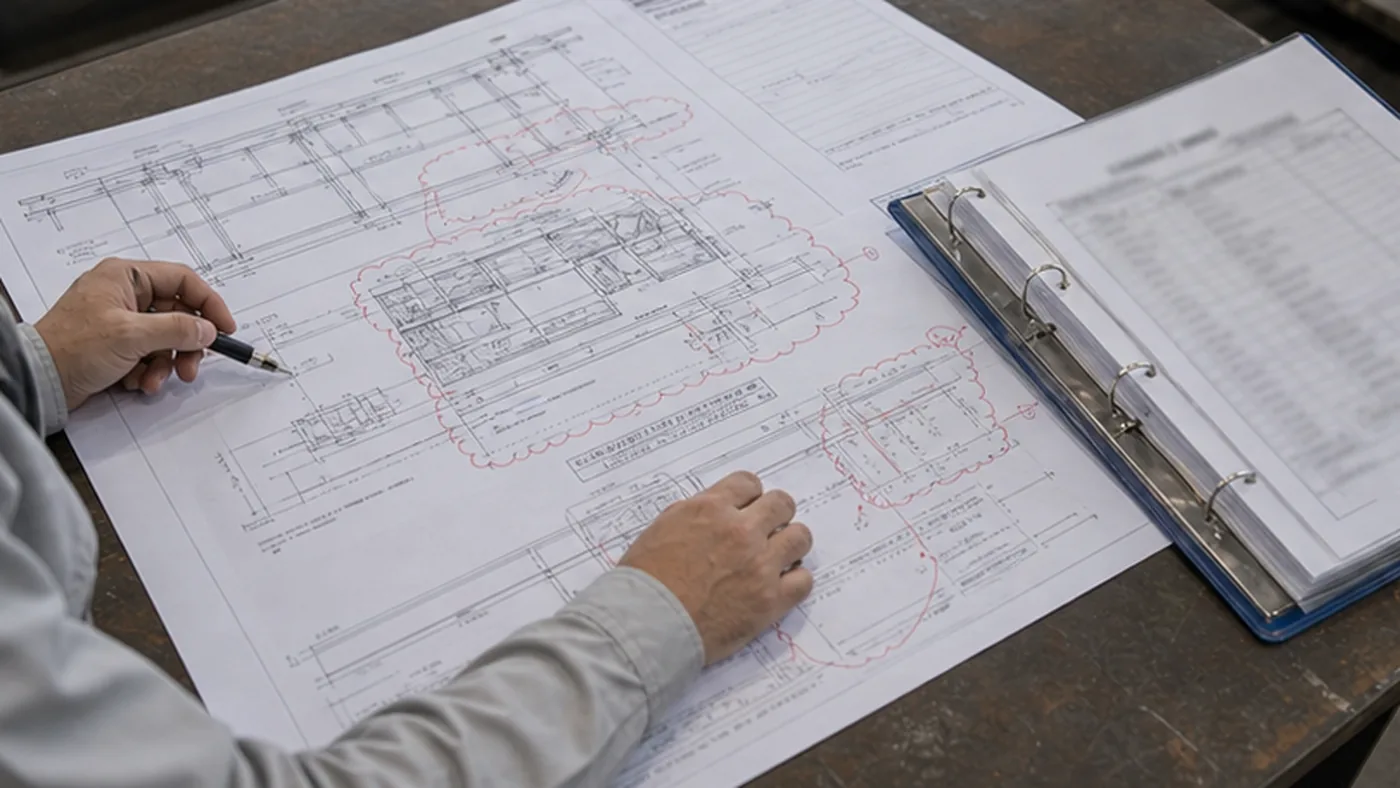
Buyer-focused answer
Quick answer for buyers
How EPC buyers review steel structure shop drawings before fabrication, including revisions, member marks, connections, quantities, tolerances, and comments.
Main question
What should EPC buyers check when using the how EPC buyers review steel structure shop drawings?
Quick answer
How EPC buyers review steel structure shop drawings before fabrication, including revisions, member marks, connections, quantities, tolerances, and comments.
When to use this page
Use it before sending RFQs, comparing quotations, or asking fabricators to clarify missing scope.
What to verify
Confirm the drawing status and revision basis; Check general arrangement and erection drawings first; Review member marks and quantities; Check connection and hole information
Related next step
How EPC buyers review steel structure shop drawings is a practical issue before fabrication starts. Shop drawings turn design information into member marks, connection details, bolt lists, assembly drawings, and erection references. If the buyer approves unclear drawings, later problems may appear as wrong quantities, missing parts, mismatched holes, packing confusion, or site installation delays.
This page is written for procurement and project teams. It is not a replacement for engineering approval, but it helps buyers organize the review process and ask better questions before releasing drawings for production.
1. Confirm the drawing status and revision basis
Before checking details, confirm that the drawing package is based on the latest design information. Many errors happen when fabricators work from an old revision or when comments are not closed before production starts.
| Review item | What to check |
|---|---|
| Drawing revision | Shop drawings match the latest structural drawings and project comments. |
| Review status | Each drawing is marked for review, approved, approved with comments, or rejected. |
| Comment closeout | Previous review comments are answered, revised, or clearly tracked. |
| Distribution control | Only the approved revision is used for fabrication, packing, and site reference. |
2. Check general arrangement and erection drawings first
Start with the big picture before reviewing individual member details. General arrangement and erection drawings should show grid lines, elevations, member locations, erection sequence, levels, bracing layout, and building area references.
- Grid dimensions and building elevations match the contract drawings.
- Column, beam, truss, bracing, purlin, and girt locations are clear.
- Component marks are visible and not duplicated incorrectly.
- Building zones or shipment areas are easy to understand.
- Notes identify design loads, standards, material grades, and special conditions where needed.
If the RFQ drawing package is still incomplete, review the steel structure quotation drawing checklist before asking for a firm fabrication quote.
3. Review member marks and quantities
Member marks connect drawings, production, inspection, packing, and site installation. The buyer should check whether the same mark appears consistently in the member list, assembly drawings, packing list, and erection drawings.
| Quantity check | Buyer question |
|---|---|
| Member schedule | Do quantities, lengths, and section sizes match the latest drawing basis? |
| Repeated members | Are repeated marks clearly identified, or should separate marks be used? |
| Loose parts | Are bolts, clips, splice plates, and small accessories included in lists? |
| Estimated weight | Does the drawing quantity align with the RFQ tonnage basis? |
For early quantity checks, use the guide on estimating steel tonnage for industrial building RFQs.
4. Check connection and hole information
Connection details are a high-risk area because small drawing errors can cause major site delays. Buyers should not approve drawings only by looking at overall member sizes. Connections, holes, plates, bolts, welds, and interface details must be coordinated.
- Bolt size, grade, quantity, and hole type are shown clearly.
- Plate thickness, dimensions, and weld requirements are identified.
- Connection details match design intent and project specifications.
- Left-hand and right-hand parts are not confused.
- Field welds, shop welds, and site bolting are separated clearly.
5. Review tolerances, coating, and fabrication notes
Shop drawings should carry the technical notes needed for production and inspection. Missing notes can create disputes about material, welding, surface treatment, marking, and packing.
| Note type | What should be clear |
|---|---|
| Material | Steel grade, bolt grade, plate grade, and any substitution control. |
| Welding | Weld symbols, size, location, inspection level, and repair expectations. |
| Coating | Surface preparation, paint system, DFT, galvanizing, and touch-up notes. |
| Tolerances | Dimensional tolerance, camber, hole tolerance, and assembly checks. |
The quality file should later connect these drawing notes to steel structure quality documents.
6. Check packing and site installation information
Shop drawings should support delivery and erection, not only fabrication. Component marks, bolt lists, bundle areas, and erection references should be usable by the site team.
- Member marks match the planned packing and erection sequence.
- Long members, heavy members, or special lifting points are identified.
- Bolts and small parts can be linked to the correct connection areas.
- Shipment batches or building zones are clear when phased delivery is planned.
Use the component marking guide and the bolt and small parts packing checklist during delivery planning.
7. Return comments in a controlled format
Review comments should be easy for the fabricator to answer. Avoid vague comments such as "please check." Instead, identify the drawing number, mark number, issue, required action, and response deadline.
- Use one comment log for all drawing review comments.
- Separate engineering comments from procurement or packing comments.
- Require the supplier to respond with revised drawing numbers.
- Do not release fabrication until critical comments are closed.
- Archive the approved revision for later inspection and shipment records.
Red flags before approval
- Shop drawings do not show the revision of the design drawings used.
- Member marks differ between erection drawings and part drawings.
- Bolt lists, small parts, and loose plates are not shown clearly.
- Coating or welding notes conflict with the RFQ requirements.
- Comments are answered by email but not reflected in revised drawings.
Buyer note
Shop drawing review should be treated as a project control point. Define the review process in the steel structure RFQ template, compare supplier assumptions with the quotation, and use drawing approval status to control fabrication release.
Buyer follow-up questions
How should buyers use this page?
Use it as a practical review aid for how epc buyers review steel structure shop drawings. The page helps the buyer confirm what must be checked, what evidence should be requested, and which follow-up actions should be closed before the package moves to the next procurement step.
When should this review happen?
Use it before issuing an RFQ or when quotations are difficult to compare because drawings, scope, or assumptions are unclear.
What evidence should be kept?
Keep the records that prove the decision, especially drawings, revision status, scope boundaries, material and coating standards, destination data, schedule assumptions, and supplier exclusions. Photos, comments, approvals, open issues, and closeout notes should stay linked to the relevant drawing, supplier reply, shipment, or handover record.
How to use this checklist
Check this buyer-side checklist against the contract, approved drawings, owner requirements, engineer instructions, and the current edition of every project-specified standard. See the editorial and source review process.